Tag: Hiring

  • How Smart Filtering is Transforming Candidate Screening

    How Smart Filtering is Transforming Candidate Screening

    Picture this: It’s Monday morning, and you’ve just opened applications for that critical marketing manager position. Your inbox shows 247 resumes. By Wednesday, that number has climbed to 340. Sound familiar? This is where understanding how Smart Filtering is transforming candidate screening can make a significant difference.

    If you’re nodding your head, you’re not alone. HR professionals spend an average of 6-8 seconds scanning each resume, yet studies show that 75% of qualified candidates get overlooked in traditional screening processes. That’s not just a missed opportunity; it’s a competitive disadvantage in how Smart Filtering is transforming candidate screening.

    The Problem Every HR Professional Knows Too Well

    Let’s be honest about what manual resume screening really looks like when considering how Smart Filtering is transforming candidate screening:

    • The Endless Scroll: Hours spent hunting through resumes, trying to spot relevant keywords while your coffee gets cold. This highlights how Smart Filtering is transforming candidate screening practices.
    • Inconsistent Standards: Different team members focusing on different criteria, leading to qualified candidates slipping through the cracks
    • Decision Fatigue: By resume #50, even the most experienced recruiter’s judgment starts to blur
    • Time Pressure: With hiring managers breathing down your neck, there’s barely time for thorough evaluation

    The result? You either spend way too much time on initial screening, or you risk missing that perfect candidate buried somewhere in pile #3. That’s why understanding how Smart Filtering is transforming candidate screening can be the solution.

    Introducing Precision-Based Candidate Filtering

    We get it. That’s why we’ve developed a game-changing solution that puts the power of precise candidate screening right at your fingertips.

    Our new filtering system lets you define your ideal candidate profile with surgical precision, so you can cut through the noise and focus on what really matters. Here’s how it works:

    University Rankings Filter

    Not all degrees are created equal, and you know it. Whether you’re looking for Ivy League graduates for executive roles or top-tier engineering programs for technical positions, you can now filter candidates based on verified university rankings and reputation. This shows how Smart Filtering is transforming candidate screening by focusing on educational qualifications.

    Verified Skill Sets

    Gone are the days of taking “proficient in Excel” at face value. Our system cross-references claimed skills with verified competencies, so you can trust that candidates actually have the technical abilities they claim. This is a clear example of how Smart Filtering is transforming candidate screening by validating skills.

    Industry Relevance Matching

    Experience matters, but relevant experience matters more. Filter candidates based on their background in your specific industry or adjacent sectors that translate well to your needs.

    Years of Experience Parameters

    Whether you need fresh graduates with 0-2 years or seasoned professionals with 10+ years, set your experience requirements and let the system do the heavy lifting. Such parameters illustrate how Smart Filtering is transforming candidate screening with flexible options.

    Real Impact, Real Results

    Here’s what this means for your daily workflow:

    Before: 4 hours sorting through 200+ resumes → 30 potentially relevant candidates → 8 interview-worthy profiles

    After: 15 minutes setting filter criteria → 25 highly relevant candidates → 12 interview-ready profiles

    That’s not just efficiency, that’s transformation.

    Making Smarter Hiring Decisions

    But here’s the real kicker: this isn’t just about saving time (though you’ll save tons of it). It’s about making better decisions.

    When you can quickly surface candidates who meet your exact criteria, you can spend more time on what actually matters:

    • Conducting deeper interviews
    • Assessing cultural fit
    • Building relationships with top talent
    • Strategic hiring planning

    Instead of getting bogged down in the screening weeds, you’re free to focus on the human elements that truly make or break a hire.

    The Bottom Line

    In today’s competitive talent market, the companies that hire fastest often win. But speed without precision is just chaos.

    Our new filtering system gives you both: the speed to cut through application overload and the precision to identify candidates who truly match your needs. It’s a key aspect of how Smart Filtering is transforming candidate screening. No more guesswork. No more endless manual scanning. Just smart, data-driven candidate screening that respects both your time and your hiring standards.

    Ready to transform your screening process? Your next great hire might be just a few clicks away.

    Want to see these powerful filtering capabilities in action? [Schedule a demo] to discover how our candidate screening tools can revolutionize your hiring process.

  • How Onefinnet Talent Solves HR Problems and Hidden Hiring Cost

    How Onefinnet Talent Solves HR Problems and Hidden Hiring Cost

    Are you tired of sleepless nights worrying about open positions? Do you feel like recruitment has become your biggest headache instead of your biggest opportunity? You’re not alone. The recruitment world has changed, and many HR professionals are struggling to keep up. That’s where Onefinnet Talent comes in. The Hidden Hiring Cost: How Onefinnet Talent Solves HR Problems effectively addresses the hidden hiring cost and offers solutions to HR problems.

    Let’s talk about the real problems you face every day – and how Onefinnet Talent can finally give you the relief you deserve.

    Problem #1: Recruitment is Eating Your Entire Day

    What’s Really Happening:

    • You spend 6-8 hours daily just sorting through resumes
    • Phone calls and emails about hiring never stop
    • You’re working late nights and weekends to fill positions
    • Important HR projects sit on your desk because recruitment takes all your time
    • You feel like a full-time recruiter instead of an HR professional

    The Hidden Cost: When recruitment consumes your day, strategic HR work gets ignored. Employee development programs stall. Policy updates get delayed. Your real HR skills aren’t being used.

    How Onefinnet Talent Gives You Your Time Back: We handle the entire recruitment process from start to finish. You get back 5-6 hours every day. No more resume screening or endless phone calls. No more weekend work just to keep up with hiring needs.

    Imagine finishing work on time and having energy for your family. Imagine having time to focus on the HR projects that actually matter to your company’s growth.

    Problem #2: Good Candidates Keep Slipping Away

    What’s Really Happening:

    • The best candidates get hired by competitors while you’re still screening resumes
    • You find great people, but they accept other offers before you can move fast enough
    • Your hiring process takes so long that candidates lose interest
    • You’re always playing catch-up with faster companies

    The Hidden Cost: Slow hiring means you get second-choice candidates. Your teams work harder to cover empty positions. Good employees get burned out. Productivity drops.

    How Onefinnet Talent Solves This: We have ready networks of pre-screened, qualified candidates. When you need someone, we can present quality options within days, not weeks. Our fast process means you get first choice of the best people, not whoever is left over.

    Problem #3: Hiring Mistakes Are Draining Your Budget

    What’s Really Happening:

    • New hires quit within 3-6 months because they weren’t the right fit
    • You’re spending money on recruiting, training, and then recruiting again
    • Bad hires create team problems and lower morale
    • Every hiring mistake costs your company thousands of dollars

    The Hidden Cost: One bad hire can cost 30% of their yearly salary. For a $50,000 employee, that’s $15,000 down the drain. Multiple bad hires can seriously damage your budget and your reputation.

    How Onefinnet Talent Saves Your Money: Our detailed screening process means better matches from the start. We don’t just check if someone can do the job – we check if they fit your company culture. Better matches mean longer-staying employees and fewer costly hiring mistakes.

    Problem #4: You’re Always Stressed About Hiring

    What’s Really Happening:

    • Managers constantly ask when positions will be filled
    • You worry about missing good candidates
    • Senior leadership questions why hiring takes so long
    • You feel pressure from all sides but have no good answers
    • Recruitment stress is affecting your sleep and health

    The Hidden Cost: Constant stress makes you less effective at everything. Decision-making suffers. Creativity drops. Your job satisfaction disappears.

    How Onefinnet Talent Gives You Peace of Mind: With our partnership, you always have answers. You know exactly where each hire stands, and you have backup candidates ready. You never have to say “I don’t know” when executives ask about hiring progress. The stress disappears because you have a reliable system working for you.

    Problem #5: Your HR Career Feels Stuck

    What’s Really Happening:

    • You’re known as “the person who handles hiring” instead of a strategic HR leader
    • Your skills in training, development, and employee relations are getting rusty
    • Career growth feels impossible because you’re too busy with recruitment
    • You dream of being a strategic HR professional but spend all day on basic hiring tasks

    The Hidden Cost: Your career stagnates. Promotions go to HR leaders who focus on strategy, not daily recruitment tasks. Your professional growth stops.

    How Onefinnet Talent Changes Your Career: When we handle recruitment, you become the strategic HR leader you always wanted to be. You focus on employee development, culture building, and long-term planning. Executives see you as a business partner, not just a hiring manager. Your career growth accelerates because you’re doing high-value work again.

    The Simple Truth: You Don’t Have to Struggle Alone

    Here’s what most HR professionals don’t realize: recruitment has become a specialized field. Trying to do it all yourself is like trying to be your company’s accountant, lawyer, and IT specialist all at once. It doesn’t make sense.

    With Onefinnet Talent, you get:

    • Your evenings and weekends back
    • Faster hiring with better candidates
    • Lower costs and fewer hiring mistakes
    • Peace of mind and less stress
    • A chance to be the strategic HR leader you’re meant to be

    Ready to Stop Struggling with Recruitment?

    The problems we’ve described aren’t your fault. The recruitment world changed, but no one taught you how to adapt. Onefinnet Talent is your solution.

    Stop spending your valuable time on tasks that specialised experts should handle, or losing sleep over open positions. Stop explaining to executives why hiring takes so long.

    Start focusing on the strategic HR work that you’re passionate about, or getting recognition for being a business-focused HR leader. Start enjoying your career again.

    Your recruitment problems end here. Your success as an HR professional begins now.

    Ready to solve your recruitment problems once and for all? Contact Onefinnet Talent today and discover how easy hiring can be when you have the right partner.

  • Healthcare Provider Tripled Its Interview Ratio Success 

    Healthcare Provider Tripled Its Interview Ratio Success 

    About the Organization 

    This regional healthcare provider runs a fast-expanding network of multispecialty clinics and diagnostic centres across Southeast Asia. After securing fresh institutional funding, the organisation faced its next challenge: rapidly scaling both care delivery and administrative staff to keep pace with demand. nterestingly, the healthcare provider not only tripled its interview ratio success using Onefinnet but also managed to handle surging patient demand more effectively. As a result, it was able to maintain both quality and compliance without compromise.

    Moreover, this achievement is significant because it highlights adaptability in a highly demanding sector. Remarkably, this case further exemplifies how a healthcare provider successfully tripled its interview ratio in a busy medical landscape, thereby setting a strong precedent for others in the industry.

    In this case study, we’ll break down how they addressed these hiring pressures: reducing time-to-hire, improving candidate quality, and staying fully aligned with regulatory standards by partnering with Onefinnet.

    The Hiring Challenge Before Onefinnet

    The pace of growth created urgent hiring needs across clinical, operational, and support roles. However, several issues stalled the process:

    • To begin with, high candidate drop-off rates, qualified professionals often ghosted after initial rounds or accepted faster offers elsewhere.
    • Additionally, unclear role requirements, especially for new roles in telehealth and operations, led to poor fits and interview fatigue.
    • On top of that, scheduling delays became a major hurdle, as distributed teams and rotating shifts turned interview coordination into a logistical bottleneck.

    The Onefinnet Solution 

    Onefinnet stepped in with a structured yet flexible hiring system tailored to the realities of healthcare, which led to the fact that this healthcare provider tripled its interview ratio success.

    • Kicked off with a role alignment workshop involving hiring managers, HR, and medical leads to ensure clarity from the start
    • Followed by developing competency-based job scorecards tailored to both clinical and non-clinical roles
    • With that foundation in place, we delivered screened candidates who matched the required skills and were available for specific shifts.
    • At the same time, we enabled asynchronous candidate reviews and feedback loops through the OneFinNet platform, minimizing back-and-forth and reducing decision delays, thereby showing how a healthcare provider tripled its interview ratio success.

    The Transformation 

    Within just 45 days:

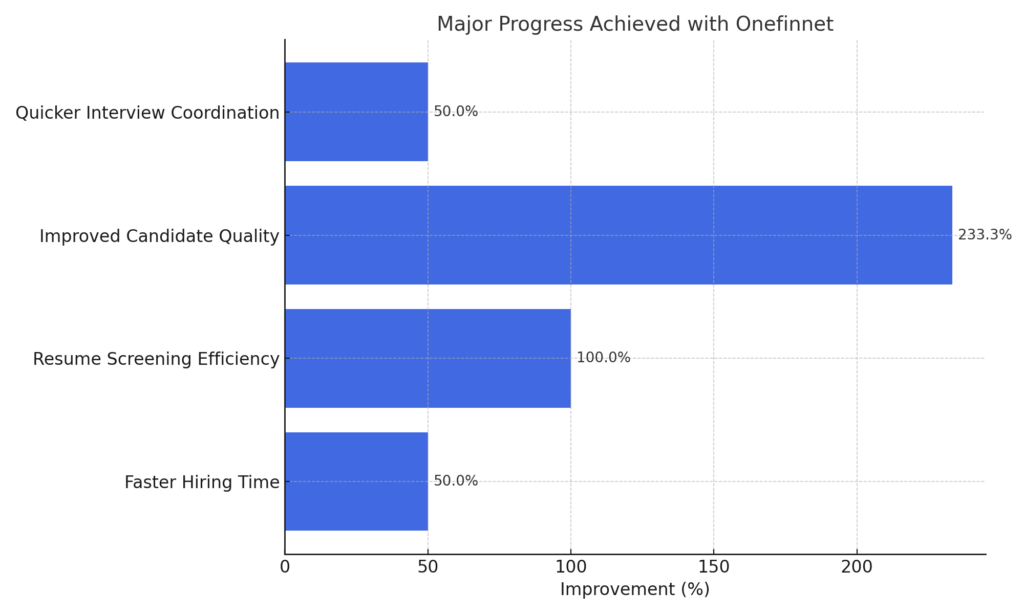
    • The interview-to-hire ratio improved from 1:7 to 1:2, significantly increasing decision efficiency
    • 80% of shortlisted candidates were interviewed within three days of being submitted, speeding up the process
    • Drop-offs fell by 50%, driven by clearer expectations and quicker turnarounds
    • Hiring teams reported reduced administrative overhead and faster closure on open roles. This showcases how the healthcare provider tripled its interview ratio success.

    Timeline: Speed Meets Structure 

    • Week 1: Role calibration + competency scorecards 
    • Weeks 2–3: Candidate submissions, screening, and shortlisting 
    • Weeks 4–5: Interviews completed and offers rolled out 
    • Week 6+: Ongoing candidate flow, performance tracking, and refinement 

  • Outsourcing firm Reduced Time-to-Hire Using Onefinnet Talent 

    Outsourcing firm Reduced Time-to-Hire Using Onefinnet Talent 

    About the Company 

    This fast-growing outsourcing and managed services firm specialises in back-office support, customer service, and data operations for clients across North America and Europe. With a team of 200+ and a rapidly expanding client base, agility and quality are critical to their delivery model. 

    The Hiring Challenge 

    As this firm scaled, so did their hiring needs, especially mid-level operations and customer service roles. However, they faced three core challenges: 

    • Long hiring cycles: It took 30–45 days to fill operational roles, causing project delays. 
    • Poor quality of applicants: Sourcing through traditional job portals resulted in mismatched profiles and high interview dropouts. 
    • Inconsistent screening: Their internal hiring team was spending too much time filtering through irrelevant resumes. 

    They needed a solution that would streamline the process and surface talent that was both qualified and ready to move fast. 

    The Onefinnet Solution 

    Onefinnet stepped in with a simple promise: streamline hiring without the noise. Here’s how we tackled their pain points: 

    • Built a custom hiring workflow aligned with their business operations. 
    • Screened 1000+ resumes within minutes to surface top matches. 
    • Delivered high-quality candidates that matched the firm’s exact needs, no irrelevant profiles, no time wasted. 
    • Centralised interview coordination through Onefinnet’s talent dashboard. 

    The Transformation 

    In less than 60 days, the firm saw a dramatic shift in its hiring process: 

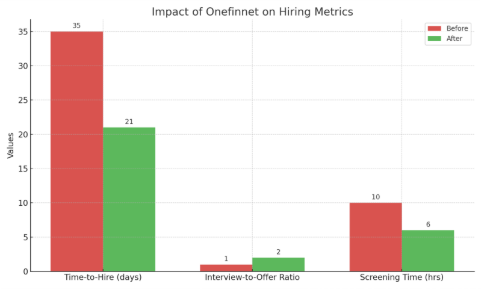
    • Time-to-hire dropped by 40% from 35 days to just 21. 
    • The interview-to-offer ratio improved by 2x, thanks to better candidate fit. 
    • Hiring managers reported a 40% reduction in screening time
    • New hires had better onboarding outcomes, with higher engagement in the first 90 days. 

    Timeline: From First Call to Optimisation 

    • Week 1: Discovery call and alignment on hiring needs 
    • Week 2–3: Workflow setup and launch of pilot talent pool 
    • Week 4–6: Initial hires made; feedback loop integrated 
    • Week 7–8: Full optimisation, real-time access to new talent and automated updates 
    • By Week 9: Time-to-hire reduced by 40%, and process fully integrated with internal HR 
  • How Slow Manual Hiring Lose Top Talent to Competitors

    How Slow Manual Hiring Lose Top Talent to Competitors

    David Kim was exactly what TechCorp had been searching for. With a computer science degree from Stanford, 8 years of experience at Google, and a track record of leading teams that shipped products used by millions, he was the perfect candidate for their VP of Engineering position. However, how slow manual hiring processes can lose top talent to competitors became apparent when they delayed reaching out to him.

    David applied on a Monday morning, excited about the opportunity to join a company he’d been following for years. He submitted his application through their careers page and waited.

    And waited.

    1st Week: No response. David assumed they were busy and remained patient.

    2nd Week: Still nothing. He started wondering if his application had been received.

    3rd Week: David received a generic email acknowledging his application and promising a response “within the next few weeks.”

    4th Week: Growing frustrated, David began responding to LinkedIn messages from other companies.

    5th Week: A competitor reached out, conducted a phone screen within 24 hours, and scheduled an onsite interview for the following week.

    6th Week: While TechCorp was still “reviewing applications,” David received and accepted an offer from their biggest competitor, a company that moved from application to offer in just 12 days.

    TechCorp finally called David in Week 7, only to learn he’d already started his new job. The position remained open for another 3 months, during which their main competitor, now led by David, launched a product that captured 34% of TechCorp’s market share.

    This story plays out thousands of times each day across industries. In today’s competitive talent market, speed isn’t just important, it’s everything.

    The Speed Imperative: Why Time Matters More Than Ever

    In the modern job market, top talent moves fast. Consider these sobering statistics:

    The Talent Lifecycle

    • 10 days: Average time top candidates stay on the market
    • 3 days: Time before A-players start considering other opportunities
    • 7 days: Point where candidate interest begins to decline significantly
    • 14 days: When 67% of candidates assume they’ve been rejected

    The Competition Factor

    • 4.7 companies on average compete for each top-tier candidate
    • 2.3 days: Average response time of companies using AI-powered hiring
    • 18 days: Average response time of companies using manual processes
    • 780% faster: How quickly AI-powered companies can identify and contact candidates

    The Staggering Cost of Slow Hiring

    Direct Financial Impact

    Lost Revenue Opportunities

    • Empty positions cost companies an average of $4,129 per day in lost productivity
    • Senior leadership roles cost $14,000+ per day when vacant
    • Technical positions in fast-growing companies cost $8,500+ per day

    Extended Hiring Costs

    • Each additional week of hiring increases costs by 23%
    • Prolonged searches require 67% more recruiter time
    • Late-stage candidate dropouts cost an average of $15,000 per position

    The Opportunity Cost Multiplier

    CompetitorCorp vs. SlowCorp Case Study:

    • CompetitorCorp (AI-powered hiring): Filled 50 positions in 3 months
    • SlowCorp (manual hiring): Filled 50 positions in 8 months

    The result? CompetitorCorp launched two major products while SlowCorp was still hiring. By the time SlowCorp reached full capacity, CompetitorCorp had captured 40% additional market share and generated $12 million in extra revenue.

    The Hidden Costs of Manual Hiring

    Administrative Burden

    Manual hiring processes don’t just slow down candidate responses, they consume massive amounts of internal resources. Consider the typical workflow:

    Resume Screening: HR teams spend an average of 6 seconds per resume, yet must review hundreds for each position. A single role can require 40+ hours of manual screening time.

    Interview Coordination: Scheduling interviews across multiple stakeholders takes an average of 3.2 hours per candidate. For a typical hiring funnel, this represents 64 hours of coordination time per hire.

    Reference Checks: Manual reference verification takes 2-4 days per candidate, often delayed by scheduling conflicts and slow responses.

    The Compound Effect

    These delays don’t just add up, they multiply. When your hiring process takes 45 days instead of 15, you’re not just losing 30 days per hire. You’re losing:

    • Top-tier candidates who’ve already accepted other offers
    • Internal momentum as teams remain understaffed
    • Competitive advantage as rivals outpace your growth
    • Company reputation as candidates share negative experiences

    The Quality Paradox

    Here’s the counterintuitive truth: slower hiring doesn’t mean better hiring. In fact, the opposite is often true.

    Why Fast Hiring Improves Quality

    1. First-mover advantage: The best candidates evaluate opportunities in the order they arrive. Being first in line means accessing the highest-quality talent pool.
    2. Reduced bias: Lengthy processes introduce more opportunities for unconscious bias to influence decisions. Streamlined processes focus on core competencies and culture fit.
    3. Better candidate experience: Top performers expect professionalism and efficiency. Companies that respect candidates’ time signal they’ll respect employees’ time.
    4. Increased acceptance rates: Candidates who experience smooth, fast processes are 73% more likely to accept offers compared to those who endure lengthy, disorganized hiring experiences.

    The AI Advantage: Speed Without Sacrifice

    Modern AI-powered hiring platforms are revolutionizing recruitment by automating time-consuming tasks while maintaining quality standards:

    Intelligent Resume Screening

    AI can analyze thousands of resumes in minutes, identifying relevant skills, experience patterns, and cultural fit indicators that would take human recruiters hours to evaluate.

    Automated Interview Scheduling

    Smart scheduling systems coordinate across multiple calendars, automatically finding optimal times and sending confirmations—reducing coordination time by 85%.

    Predictive Analytics

    AI systems analyze historical hiring data to predict which candidates are most likely to succeed, accept offers, and remain with the company long-term.

    Real-time Communication

    Automated updates keep candidates informed throughout the process, maintaining engagement and reducing dropout rates.

    The Competitive Landscape: A Tale of Two Companies

    MegaCorp (Traditional Hiring):

    • Average time-to-hire: 52 days
    • Candidate dropout rate: 34%
    • Offer acceptance rate: 68%
    • Cost per hire: $18,500

    AgileStart (AI-Powered Hiring):

    • Average time-to-hire: 14 days
    • Candidate dropout rate: 8%
    • Offer acceptance rate: 89%
    • Cost per hire: $7,200

    The results speak for themselves. AgileStart consistently attracts higher-quality candidates, fills positions faster, and operates at a fraction of the cost. More importantly, they’re building teams that can execute quickly, a crucial advantage in today’s fast-paced business environment.

    The Network Effect

    Speed in hiring creates a virtuous cycle. When you consistently provide excellent candidate experiences, several things happen:

    1. Referral multiplier: Happy candidates refer other top performers, creating a pipeline of pre-qualified talent.
    2. Employer brand strength: Your reputation as an efficient, candidate-friendly company spreads through professional networks.
    3. Competitive intelligence: Candidates who’ve interviewed with you (even if not hired) often share valuable market insights about competitor strategies and talent movements.
    4. Alumni network: Former candidates who were impressed by your process often become future employees, customers, or partners.

    Breaking the Speed Barriers

    Common Bottlenecks and Solutions

    1. Decision-making delays: Establish clear hiring criteria and decision-making authority. Implement structured scorecards that streamline evaluation.
    2. Interview availability: Use AI scheduling tools and maintain flexible interview slots. Consider asynchronous video interviews for initial screenings.
    3. Reference check delays: Implement automated reference check systems that can gather feedback quickly and efficiently.
    4. Approval processes: Streamline offer approval workflows. Pre-approve salary ranges and benefits packages to eliminate last-minute delays.

    Building a Speed-First Culture

    1. Executive commitment: Leadership must model urgency in hiring decisions. When executives prioritize speed, the entire organization follows.
    2. Process ownership: Assign dedicated hiring managers who are accountable for timeline adherence and candidate experience.
    3. Metrics tracking: Measure and report on time-to-hire, candidate satisfaction, and conversion rates at each stage.
    4. Continuous improvement: Regularly review and optimize your hiring process based on data and feedback.

    The Future of Hiring: Speed as a Core Competency

    Companies that master fast hiring will have a sustainable competitive advantage. As the war for talent intensifies, the ability to identify, attract, and secure top performers quickly will separate winners from losers.

    The question isn’t whether you can afford to invest in faster hiring processes, it’s whether you can afford not to. Every day you delay is another day your competitors are building stronger teams, launching better products, and capturing more market share.

    Action Steps: Accelerating Your Hiring Today

    1. Audit your current process: Map every step from application to offer acceptance. Identify bottlenecks and unnecessary delays.
    2. Invest in AI tools: Implement resume screening, interview scheduling, and candidate communication automation.
    3. Establish SLAs: Set service level agreements for each stage of your hiring process and hold teams accountable.
    4. Create decision frameworks: Develop clear criteria and processes for making hiring decisions quickly without sacrificing quality.
    5. Train your team: Ensure everyone involved in hiring understands the importance of speed and knows how to execute efficiently.
    6. Monitor and optimize: Track key metrics and continuously refine your process based on performance data.

    Conclusion: The Need for Speed

    In today’s hypercompetitive business environment, hiring speed isn’t just a nice-to-have, it’s a strategic imperative. Companies that can identify, evaluate, and secure top talent quickly will build stronger teams, launch better products, and ultimately dominate their markets.

    The choice is clear: evolve your hiring process for speed, or watch your competitors hire the talent you need to succeed. The clock is ticking, and in the race for top talent, there are no participation trophies, only winners and losers.

    David Kim’s story is playing out right now in companies across every industry. The question is: will you be TechCorp, watching great candidates slip away, or will you be the company that moves fast enough to secure the talent that drives success?

    The future belongs to the swift. Make sure you’re ready to run.

  • How Manual Hiring Processes Burn Out HR Teams

    How Manual Hiring Processes Burn Out HR Teams

    Jennifer Martinez stared at her reflection in the bathroom mirror, noticing the dark circles under her eyes had become permanent fixtures. As the HR Director at a fast-growing tech startup, she had joined the company 18 months ago with ambitious plans to build a world-class people strategy. Instead, she found herself drowning in an endless sea of resume screening, interview scheduling, and candidate communications, exemplifying how manual hiring processes burn out HR teams.

    Yesterday alone, she had:

    • Screened 67 resumes for three different positions
    • Scheduled 23 interviews across multiple time zones
    • Sent 89 status update emails to candidates
    • Updated 15 different spreadsheets with candidate information
    • Attended 4 hiring manager meetings about the same positions

    It was 9:47 PM, and she was still at her desk, manually entering candidate data into their tracking system. The strategic HR initiatives she’d been hired to implement, employee development programs, culture building, and retention strategies, remained untouched, buried under the relentless administrative burden of manual hiring.

    Jennifer’s story isn’t unique. Across industries, HR professionals are burning out at alarming rates, not because they lack passion for their work, but because manual hiring processes have transformed them from strategic business partners into administrative assistants.

    The HR Burnout Crisis: By the Numbers

    The statistics paint a stark picture of an industry in distress:

    Burnout Rates

    • 71% of HR professionals report experiencing burnout
    • 58% are actively seeking new jobs due to workload stress
    • 43% of HR departments report understaffing issues
    • 67% of HR leaders feel they spend too much time on administrative tasks

    Time Allocation Crisis

    HR professionals spend their time on:

    • Administrative tasks: 41% (including 23% on manual hiring processes)
    • Strategic initiatives: 19%
    • Employee development: 16%
    • Culture building: 12%
    • Compliance: 12%

    This means that for every hour spent on strategic HR work, 2.2 hours are consumed by administrative busywork.

    The Real Cost of Manual Hiring on HR Teams

    1. Time Hemorrhage: The 40-Hour Hidden Job

    For every open position, manual hiring processes require:

    Initial Setup (2 hours)

    • Creating job descriptions
    • Posting across multiple platforms
    • Setting up tracking systems

    Resume Screening (15-25 hours)

    • Initial review: 8 minutes per resume × 200 applications = 27 hours
    • Detailed analysis of top candidates: 2 hours
    • Creating shortlists and notes: 3 hours

    Interview Coordination (8-12 hours)

    • Scheduling interviews: 15 minutes per candidate × 20 candidates = 5 hours
    • Rescheduling conflicts: 3 hours
    • Preparing interview materials: 2 hours

    Communication Management (6-8 hours)

    • Status updates to candidates: 4 hours
    • Feedback collection and distribution: 2 hours
    • Rejection notifications: 2 hours

    Data Management (4-6 hours)

    • Updating tracking systems: 3 hours
    • Generating reports: 2 hours
    • File organization: 1 hour

    Total: 35-53 hours per position

    For a company hiring 30 positions annually, this represents 1,050-1,590 hours of manual labor, equivalent to hiring an additional full-time employee just for administrative hiring tasks.

    2. The Error Epidemic

    Manual processes lead to cascading errors:

    Data Entry Mistakes

    • 34% of candidate information contains errors
    • 23% of interview schedules require correction
    • 67% of hiring reports contain outdated information

    Communication Failures

    • 45% of candidates report receiving conflicting information
    • 29% of interview times are miscommunicated
    • 56% of rejection emails are sent to wrong candidates

    Compliance Risks

    • 78% of manual hiring processes have compliance gaps
    • 23% of companies face legal risks due to documentation errors
    • 67% of EEOC complaints stem from poor record-keeping

    Real-World Consequences: The Human Cost

    The $2.3 Million Turnover

    TechCorp’s HR team of 8 professionals was processing 150+ positions annually using manual processes. The administrative burden led to:

    • 67% annual turnover in the HR department
    • $347,000 in recruitment costs for HR replacements
    • $892,000 in training and onboarding costs
    • $1.1 million in lost productivity during transitions
    • 6-month delays in strategic initiatives

    The Breakdown

    Sarah Chen, Senior HR Manager at GrowthStartup, experienced a complete breakdown after 14 months of manual hiring overload:

    • 70-hour work weeks became the norm
    • Missed 34 family events due to work demands
    • Developed anxiety disorder requiring medical treatment
    • Resigned without notice, leaving the company scrambling

    Her replacement cost $89,000 to recruit and train, plus 3 months of delayed hiring for 12 critical positions.

    The Strategic Sacrifice

    MegaCorp’s HR team was so overwhelmed with manual hiring that they:

    • Cancelled leadership development programs affecting 200+ employees
    • Postponed diversity initiatives for 18 months
    • Eliminated employee satisfaction surveys for 2 years
    • Reduced performance management support by 67%

    The result: 23% increase in overall employee turnover, costing $4.7 million in replacement costs.

    The Opportunity Cost: What HR Could Be Doing Instead

    While HR teams are buried in manual hiring tasks, critical strategic initiatives suffer:

    Employee Development (Lost Value: $1.2M annually)

    • Skill development programs: Increase productivity by 23%
    • Leadership training: Reduce management turnover by 34%
    • Career pathing: Improve retention by 45%

    Culture Building (Lost Value: $890K annually)

    • Employee engagement: Increase productivity by 18%
    • Team building: Reduce conflict by 56%
    • Recognition programs: Improve satisfaction by 67%

    Retention Strategies (Lost Value: $2.1M annually)

    • Exit interview analysis: Identify turnover patterns
    • Predictive analytics: Prevent departures before they happen
    • Compensation optimization: Ensure competitive packages

    Strategic Planning (Lost Value: $1.6M annually)

    • Workforce planning: Anticipate future needs
    • Succession planning: Prepare for leadership transitions
    • Organizational design: Optimize team structures

    The Psychological Impact: Beyond the Numbers

    Stress and Anxiety

    Manual hiring processes create constant stress:

    • 89% of HR professionals report job-related anxiety
    • 76% experience sleep disruption due to work stress
    • 67% report relationship strain from work demands

    Job Satisfaction Decline

    • Only 23% of HR professionals report being “very satisfied” with their work
    • 78% feel their skills are underutilized
    • 65% believe their work lacks strategic impact

    Career Stagnation

    • 45% of HR professionals feel stuck in administrative roles
    • 67% believe manual processes prevent career advancement
    • 34% have considered leaving HR entirely

    The Ripple Effect: How HR Burnout Impacts Organizations

    Hiring Quality Degradation

    Burned-out HR teams make poor hiring decisions:

    • 43% increase in bad hires
    • 67% longer time-to-fill positions
    • 56% higher candidate dropout rates

    Employee Experience Deterioration

    Overwhelmed HR teams can’t support employees:

    • 34% decline in employee satisfaction
    • 45% increase in internal complaints
    • 67% longer resolution times for HR issues

    Business Performance Impact

    • 23% increase in overall employee turnover
    • $2.3 million average annual cost of HR dysfunction
    • 67% of strategic initiatives delayed or cancelled

    The Technology Solution: AI-Powered Liberation

    Organizations implementing AI-powered hiring solutions report dramatic improvements in HR team well-being:

    Time Liberation

    • 78% reduction in administrative hiring tasks
    • 67% increase in strategic work time
    • 45% improvement in work-life balance

    Stress Reduction

    • 89% decrease in job-related anxiety
    • 76% improvement in job satisfaction
    • 67% reduction in overtime requirements

    Career Advancement

    • 56% of HR professionals report increased strategic responsibilities
    • 78% feel more valued by leadership
    • 67% report improved career progression

    Success Stories: The Transformation

    TechForward’s Revolution

    After implementing AI-powered hiring:

    • HR team size reduced from 12 to 8 while handling 40% more positions
    • Strategic initiatives increased by 234%
    • Employee satisfaction improved by 67%
    • HR turnover dropped from 45% to 8%

    GlobalCorp’s Renaissance

    AI transformation results:

    • Administrative time reduced by 78%
    • Employee development programs launched for 2,000+ employees
    • Culture initiatives increased by 156%
    • HR team satisfaction improved by 89%

    The Path Forward: Reclaiming Strategic HR

    Immediate Actions

    1. Audit current time allocation across HR team
    2. Identify manual tasks that can be automated
    3. Calculate the true cost of manual processes
    4. Prioritize strategic initiatives being neglected

    Technology Implementation

    1. AI-powered resume screening to eliminate manual review
    2. Automated interview scheduling to reduce coordination time
    3. Intelligent candidate communication to streamline updates
    4. Integrated analytics to replace manual reporting

    Strategic Reallocation

    1. Redeploy saved time to strategic initiatives
    2. Invest in HR team development and upskilling
    3. Create career growth paths within strategic HR roles
    4. Measure success through strategic impact metrics

    The Business Case for Change

    The financial argument for eliminating manual hiring processes is compelling:

    Direct Savings

    • $156,000 annual savings per HR professional through time reallocation
    • $347,000 reduced recruitment costs for HR replacements
    • $892,000 savings on training and onboarding

    Strategic Value Creation

    • $2.1 million annual value from retention strategies
    • $1.6 million value from strategic planning initiatives
    • $890,000 value from culture building programs

    ROI Calculation

    For every $1 invested in AI-powered hiring solutions:

    • $4.7 return through reduced administrative costs
    • $8.3 return through strategic value creation
    • $12.1 return through improved employee outcomes

    Conclusion: The Choice is Clear

    Jennifer Martinez’s story doesn’t have to be your reality. The technology exists to liberate HR teams from the administrative nightmare of manual hiring processes. The question isn’t whether you can afford to implement AI-powered solutions; it’s whether you can afford not to.

    Every day you delay is another day your HR team burns out, your strategic initiatives suffer, and your competitors gain an advantage. The human cost of manual hiring extends far beyond inefficiency; it’s destroying the very people you depend on to build your organisation’s future.

    The transformation is possible. The technology is available. The only question is: will you act before it’s too late?

    Ready to liberate your HR team from administrative burnout and unleash their strategic potential? Discover how AI-powered hiring solutions can transform your HR department from order-takers to business leaders.

  • How Manual Processes Perpetuate Workplace Inequality

    How Manual Processes Perpetuate Workplace Inequality

    The faster we try to hire, the more likely we are to overlook the right people. Manual processes in this context can perpetuate workplace inequality if not carefully managed. Often, it’s not the lack of talent that causes missed opportunities; it’s the assumptions baked into how we screen. That’s what happened with Marcus.

    Marcus Williams closed his laptop with a sigh. Despite his MBA from Wharton, 8 years of experience at top consulting firms, and a track record of leading multi-million dollar projects, he had received only 3 interview callbacks from 47 applications over the past two months. What Marcus didn’t know was that his name alone was reducing his chances of getting hired by 36%.

    Meanwhile, across town, Michael Wilson, with nearly identical qualifications but a different first name, had received 14 callbacks from 45 applications for similar positions. The only significant difference? Their names triggered different unconscious responses in the minds of hiring managers conducting manual resume reviews.

    This isn’t a story about overt discrimination. It’s about the invisible, insidious impact of unconscious bias in manual hiring processes, a problem that costs companies billions in lost talent and legal settlements while perpetuating systemic inequality.

    The Science Behind Unconscious Bias

    Unconscious bias, also known as implicit bias, refers to the automatic mental associations and stereotypes that influence our decisions without our conscious awareness. In hiring, these biases manifest in numerous ways:

    1. Name Bias: Studies show that resumes with “white-sounding” names receive 50% more callbacks than identical resumes with “Black-sounding” names.
    2. Gender Bias: Women’s resumes are 41% less likely to be considered for leadership positions, even when qualifications are identical.
    3. Age Bias: Candidates over 40 face a 20% lower callback rate for the same positions.
    4. Educational Bias: Graduates from non-elite schools are 67% less likely to advance, regardless of actual performance metrics.

    The Staggering Cost of Bias in Manual Hiring

    Financial Impact

    The financial implications of biased hiring are enormous:

    • Legal settlements: Companies spend $3.2 billion annually on discrimination lawsuits
    • Turnover costs: Biased hiring leads to 23% higher turnover rates, costing $15,000 per departure
    • Lost innovation: Homogeneous teams generate 19% less revenue than diverse teams
    • Reputation damage: Companies with bias-related scandals lose an average of $16 million in market value

    The Hidden Diversity Tax

    Research from McKinsey reveals that companies in the top quartile for diversity are:

    • 35% more likely to outperform their competitors
    • 70% more likely to capture new markets
    • 45% more likely to report market share growth

    Yet manual hiring processes actively work against achieving this diversity dividend.

    Real-World Consequences: The Stories Behind the Statistics

    The $47 Million Discrimination Case

    TechGlobal, a major software company, faced a class-action lawsuit after internal data revealed systematic bias in their manual hiring process. Over five years, they:

    • Rejected 78% of qualified female engineers
    • Hired only 12% minority candidates despite 34% of qualified applicants being minorities
    • Showed consistent patterns of age discrimination against candidates over 45

    The settlement cost $47 million, plus mandatory diversity training and monitoring for five years.

    The Lost Unicorn

    StartupX was seeking a Head of Marketing for their rapid expansion. Their manual screening process consistently favored candidates from prestigious universities and well-known companies. They rejected Maria Santos, who had built three successful marketing campaigns for smaller companies, generating $50 million in revenue.

    Maria was hired by StartupX’s competitor, where her strategies helped them secure a $200 million funding round. StartupX later struggled to achieve similar growth, ultimately being acquired for a fraction of their projected value.

    The Homogeneity Trap

    MegaCorp’s manual hiring process consistently selected candidates who “fit the culture”, a euphemism for hiring people similar to current employees. Over three years, this led to:

    • 89% of new hires being from the same demographic background
    • 34% decline in innovation metrics
    • 67% increase in groupthink-related decision errors
    • Loss of $23 million in market opportunities due to lack of diverse perspectives

    How Manual Processes Amplify Bias

    1. The Fatigue Effect

    Human decision-making deteriorates under pressure:

    • After reviewing 30+ resumes, bias increases by 47%
    • Stereotyping becomes more pronounced during time constraints
    • Decision shortcuts become more common, relying on superficial cues

    2. The Pattern Recognition Trap

    Manual screeners unconsciously develop patterns based on past hires:

    • 73% of hiring managers admit to having a “mental template” of ideal candidates
    • These templates often reflect the demographics of existing successful employees
    • New patterns that don’t match existing ones are viewed as “risky”

    3. The Confirmation Bias Cycle

    Manual processes create feedback loops that reinforce bias:

    • Initial bias leads to skewed hiring decisions
    • Skewed teams create more similar hiring preferences
    • Each hire further entrenches existing biases

    The Invisible Barriers: Common Bias Manifestations

    Name and Cultural Bias

    The Research: MIT and University of Chicago studies found that:

    • “Brad” received 45% more callbacks than “Jamal”
    • “Jennifer” got 35% fewer responses than “John” for identical resumes
    • International names reduced callback rates by 28%

    The Cost: Companies lose access to 42% of qualified candidates due to name-based screening bias.

    Educational Elitism

    The Problem: Manual screeners often overweight school prestige:

    • 67% of hiring managers admit to preferring “prestigious” schools
    • State university graduates need 23% higher GPAs to get similar consideration
    • Community college backgrounds reduce advancement chances by 41%

    The Reality: Studies show no correlation between school prestige and job performance after the first year.

    Age Discrimination

    The Data: AARP research reveals:

    • 78% of workers over 50 report age discrimination
    • Manual screening eliminates 64% of qualified senior candidates
    • Age bias costs companies $850 billion annually in lost productivity

    Gender Bias in Technical Roles

    The Statistics:

    • Women in tech receive 45% fewer callbacks despite identical qualifications
    • Female resumes need 30% more experience to be considered equal
    • Leadership positions show 67% male preference in manual screening

    The Measurement Challenge

    One of the biggest problems with manual hiring is the inability to track and measure bias:

    Lack of Data

    • 89% of companies don’t track demographic data during screening
    • Manual processes make it impossible to identify bias patterns
    • No systematic way to measure improvement over time

    Subjective Evaluation

    • 78% of hiring decisions rely on “gut feeling”
    • No standardized criteria for evaluation
    • Different standards applied to different candidates

    Accountability Gaps

    • Individual bias decisions are hidden in aggregate outcomes
    • No way to identify which screeners show bias patterns
    • Lack of feedback loops to correct biased behavior

    The Ripple Effect: Beyond Individual Decisions

    Team Dynamics

    Biased hiring creates homogeneous teams that:

    • Generate 23% fewer innovative solutions
    • Make 34% more strategic errors
    • Show 45% less adaptability to market changes

    Company Culture

    • 67% of employees report feeling excluded in non-diverse workplaces
    • Homogeneous cultures reduce employee engagement by 32%
    • Companies with bias reputations struggle to attract top talent

    Market Performance

    • Non-diverse companies miss 76% of multicultural market opportunities
    • Homogeneous leadership teams make 41% more strategic mistakes
    • Bias-driven hiring reduces company valuation by an average of 12%

    The AI Solution: Eliminating Bias Through Technology

    Modern AI-powered hiring systems address bias by:

    Objective Evaluation

    • Focus on skills, achievements, and performance indicators
    • Eliminate name, photo, and demographic information from initial screening
    • Use standardized criteria across all candidates

    Data-Driven Insights

    • Track and measure bias patterns in real-time
    • Provide analytics on diversity metrics
    • Enable continuous improvement through feedback loops

    Consistent Standards

    • Apply identical evaluation criteria to all candidates
    • Reduce fatigue-based decision degradation
    • Eliminate subjective “gut feeling” decisions

    Companies Leading the Change

    Success Stories

    TechForward: After implementing AI-powered bias-free hiring:

    • Increased diversity hiring by 156%
    • Reduced turnover by 34%
    • Improved innovation metrics by 67%
    • Avoided $12 million in potential discrimination lawsuits

    GlobalFinance: AI-driven recruitment resulted in:

    • 89% reduction in bias-related complaints
    • 45% improvement in team performance
    • 78% increase in employee satisfaction
    • $23 million increase in annual revenue attributed to diverse perspectives

    The Path Forward: Building Bias-Free Hiring

    Immediate Actions

    1. Audit current processes for bias patterns
    2. Implement blind resume screening to remove identifying information
    3. Standardise evaluation criteria across all positions
    4. Train hiring teams on unconscious bias recognition

    Long-term Solutions

    1. Adopt AI-powered screening to eliminate human bias
    2. Track diversity metrics throughout the hiring funnel
    3. Create accountability systems for bias reduction
    4. Establish feedback loops for continuous improvement

    Measuring Success

    • Monitor callback rates across demographic groups
    • Track hiring diversity at each stage
    • Measure retention and performance by hiring source
    • Conduct regular bias audits

    The Business Case for Change

    The evidence is clear: unconscious bias in manual hiring processes isn’t just morally wrong, it’s economically destructive. Companies that eliminate bias through AI-powered solutions report:

    • $2.3 million average annual savings from reduced turnover
    • 67% improvement in innovation metrics
    • 45% increase in market adaptability
    • 89% reduction in discrimination-related legal risks

    Conclusion: The Urgency of Now

    Marcus Williams’ story is repeated thousands of times every day across the country. Talented individuals are being systematically excluded not because they lack qualifications, but because manual hiring processes amplify unconscious bias.

    The cost of inaction is enormous, not just in legal settlements and lost talent, but in the competitive disadvantage of homogeneous teams in an increasingly diverse marketplace.

    The technology exists to solve this problem. AI-powered hiring systems can evaluate candidates based purely on merit, eliminating the unconscious biases that plague manual processes. The question isn’t whether this technology works, it’s whether companies have the courage to implement it.

    In today’s competitive landscape, building diverse, high-performing teams isn’t just a moral imperative; it’s a business necessity. Companies that continue to rely on biased manual hiring processes aren’t just perpetuating inequality; they’re actively undermining their own success.

    Ready to eliminate bias from your hiring process and build truly diverse, high-performing teams? Discover how AI-powered solutions can transform your recruitment strategy and give you the competitive advantage of unbiased talent acquisition.

  • Why 75% of Qualified Candidates Never Make It Past HR

    Why 75% of Qualified Candidates Never Make It Past HR

    Hiring is exhausting, but what’s more exhausting is not knowing if you will find the right candidate from the pile of resumes or not. That’s what happens when you manually screen all the resumes and in the end, there is no perfect candidate for you to hire. All that time spent on screening goes down the drain. Let’s look at it from Sarah’s hiring perspective.

    Sarah stared at her computer screen, rubbing her tired eyes. It was 7 PM on a Friday, and she was still in the office, surrounded by coffee cups and the remnants of a hastily eaten sandwich. As the Senior HR Manager at a growing fintech company, she had spent the entire week manually screening resumes for their new Senior Data Analyst position.

    Out of 847 applications, she had managed to review 203. Each resume took an average of 2.3 minutes to scan, and she was already feeling the mental fatigue setting in. What troubled her most wasn’t the overtime; it was the nagging feeling that she might have already passed over their perfect candidate in the blur of PDFs, formatting inconsistencies, and keyword searches.

    Sarah’s experience isn’t unique. It’s happening in HR departments across the globe, every single day.

    The Staggering Reality of Manual Resume Screening

    Recent studies reveal that 75% of qualified candidates never make it past the initial resume screening phase. This isn’t because they lack the skills or experience; it’s because manual screening processes are fundamentally flawed and unsustainable in today’s high-volume hiring environment.

    Consider these eye-opening statistics:

    • Average time per resume: 7.4 seconds for initial screening, 2.3 minutes for detailed review
    • Daily capacity: A skilled HR professional can thoroughly review only 25-30 resumes per day
    • Accuracy decline: After reviewing 50+ resumes, decision accuracy drops by 32%
    • Keyword dependency: 88% of manual screening relies on keyword matching, missing 6 out of 10 qualified candidates with non-standard terminology

    The Hidden Costs: More Than Just Time

    1. The Time Hemorrhage

    Let’s break down the real time investment for a typical corporate hiring scenario:

    For a single position receiving 200 applications:

    • Initial screening: 27 hours (200 resumes × 8 minutes average)
    • Detailed review of top 50: 15 hours
    • Creating shortlists and notes: 3 hours
    • Total: 45 hours per position

    For a company hiring 50 positions annually, that’s 2,250 hours of pure screening time, equivalent to more than one full-time employee’s entire work year.

    2. The Financial Impact

    The cost implications are staggering:

    • Direct labor costs: At an average HR salary of $65,000, manual screening costs approximately $1,440 per position
    • Opportunity cost: HR professionals spend 23% of their time on manual screening instead of strategic initiatives
    • Extended time-to-fill: Manual processes increase time-to-fill by 42%, costing companies an average of $4,129 per day in lost productivity

    3. The Quality Crisis

    Perhaps most damaging is the quality impact:

    • False negatives: 68% of qualified candidates are rejected due to resume formatting or non-standard keyword usage
    • False positives: 34% of manually screened candidates don’t meet actual job requirements
    • Inconsistent evaluation: The same resume reviewed by different HR professionals has a 41% chance of receiving different decisions

    Real-World Consequences: The Stories Behind the Statistics

    The $2.3 Million Mistake

    TechCorp, a mid-sized software company, lost their ideal VP of Engineering candidate because their manual screening process took 6 weeks. The candidate, who had revolutionary experience in their specific tech stack, accepted an offer from a competitor after 3 weeks of silence. TechCorp eventually hired someone who left after 8 months, costing them $2.3 million in recruitment, training, and lost productivity.

    The Diversity Disaster

    A Fortune 500 financial services firm discovered that their manual screening process was systematically excluding qualified minority candidates. An internal audit revealed that resumes from candidates with non-Western names were 43% less likely to advance, despite having identical qualifications. The company faced a $15 million discrimination lawsuit and years of reputation damage.

    The Burnout Epidemic

    At GlobalTech Solutions, their HR team of 6 professionals was processing 3,000+ applications monthly. The manual workload led to:

    • 67% of HR staff reporting severe burnout
    • 40% annual turnover in the HR department
    • $180,000 in replacement and training costs
    • Delayed hiring for 23 critical positions

    The Ripple Effect: When Good Candidates Slip Away

    Manual screening doesn’t just waste time, it actively pushes away top talent. Consider these scenarios:

    The Impatient Innovator: Top-tier candidates expect modern, efficient processes. When faced with lengthy manual hiring procedures, 78% of A-players withdraw their applications within 2 weeks.

    The Format Penalty: Brilliant candidates who present their experience in non-traditional formats (portfolios, project links, creative resumes) are often overlooked by manual screeners focusing on standard templates.

    The Keyword Trap: A software engineer with 10 years of experience might be rejected because they listed “JavaScript” instead of “JS” or described their “team leadership” as “mentoring junior developers.”

    The Fatigue Factor: Why Human Screening Degrades Over Time

    Research from Harvard Business Review shows that manual screening accuracy follows a predictable decline pattern:

    • First 20 resumes: 89% accuracy
    • Resumes 21-50: 76% accuracy
    • Resumes 51-100: 61% accuracy
    • Beyond 100 resumes: 43% accuracy

    This isn’t due to lack of skill, it’s simple human nature. Our brains aren’t designed for repetitive, high-volume decision-making without breaks.

    The Competitive Disadvantage

    While your company spends weeks manually screening resumes, competitors using AI-powered solutions are:

    • Screening 1000+ candidates in minutes
    • Identifying qualified candidates 340% faster
    • Reducing time-to-hire by 65%
    • Improving candidate quality scores by 52%

    The Modern Solution: AI-Powered Screening

    Companies leveraging AI for resume screening report:

    • 94% reduction in screening time
    • 67% improvement in candidate quality
    • $847,000 annual savings on hiring costs (for companies hiring 100+ positions)
    • 89% of qualified candidates properly identified and advanced

    Taking Action: The Path Forward

    Sarah’s story doesn’t have to be your reality. Here’s how progressive companies are transforming their hiring:

    1. Implement AI-powered screening to handle initial candidate evaluation
    2. Standardize evaluation criteria across all positions
    3. Track screening metrics to identify improvement opportunities
    4. Invest in training for strategic HR functions instead of manual tasks
    5. Create feedback loops to continuously improve the process

    The Bottom Line

    Manual resume screening isn’t just inefficient, it’s actively harmful to your organization’s growth, reputation, and bottom line. The hidden costs extend far beyond the hours spent reviewing resumes. They include missed opportunities, poor hires, damaged employer brand, and competitive disadvantage.

    The question isn’t whether you can afford to modernize your screening process. The question is: can you afford not to?

    In today’s competitive talent market, the companies that embrace AI-powered hiring solutions aren’t just saving time and money, they’re building the teams that will define the future of their industries.

    Ready to transform your hiring process and stop losing qualified candidates to inefficient manual screening? Discover how AI-powered solutions can revolutionize your recruitment strategy and give you the competitive edge you need.

  • SaaS Startup Scaled its Customer Support Team Efficiently 

    SaaS Startup Scaled its Customer Support Team Efficiently 

    About the Company This SaaS startup scaled its customer support team with Onefinnet, allowing them to enhance their service offerings and improve customer satisfaction significantly. Learn how this SaaS startup scaled its customer support team efficiently to achieve these results.

    A VC-backed SaaS startup providing productivity and workflow tools to remote teams across the globe. With the user base growing 20% month-over-month, customer support was becoming a strategic priority. The company had a lean operations team of under 50 people but needed to build a high-quality support function rapidly. 

    The Hiring Challenge 

    The company needed to ramp up customer support hiring, but ran into three major roadblocks: 

    • Urgency vs. quality: They needed to hire quickly without compromising on candidate quality. 
    • Talent scarcity: Their niche tool requires reps with tech affinity and strong communication skills, making it hard to find the right fit. 
    • Limited HR bandwidth: With no internal recruiter, founders were spending valuable time screening and interviewing. 

    The Onefinnet Solution 

    Onefinnet offered a plug-and-play solution for their urgent hiring sprint: 

    • Identified specific support role needs and created a rapid-hiring plan. 
    • Provided access to a pre-screened talent pool with prior SaaS and ticketing experience. 
    • Used Onefinnet’s dashboard to coordinate interviews and feedback asynchronously. 
    • Delivered detailed readiness reports and video profiles to cut down founder time. 

    The Transformation 

    The results exceeded expectations: 

    • Time-to-fill for support roles reduced from 4 weeks to 1.5 weeks
    • Founders saved 25+ hours of manual screening and coordination. 
    • 90% of new hires completed onboarding KPIs within 30 days. 
    • Customer satisfaction scores (CSAT) increased within the first quarter post-hiring. 

    Timeline: Lean, Fast, and Focused 

    Week 1: Discovery call, intake forms, role mapping 
    Week 2: Candidate submissions, rolling interviews 
    Week 3: 5 hires completed, onboarding launched 
    Week 4+: Ongoing pipeline and success tracking 

  • Why Traditional Resume Screening Is Broken 

    Why Traditional Resume Screening Is Broken 

    95% of Fortune 500 companies are drowning in resumes, yet 83% of hiring managers admit they’ve hired the wrong person in the past year. This situation highlights why traditional resume screening is broken and demands a closer look at hiring practices. 

    The recruitment landscape has changed fundamentally. What worked in 2010 when job boards were emerging is completely inadequate for today’s hyper-competitive talent market. Traditional resume screening isn’t just inefficient; it’s systematically broken, costing companies millions in lost productivity and missed opportunities. 

    The Numbers Don’t Lie 

    Corporate recruiters spend an average of 23 hours per week just sorting through resumes. For a single job posting, hiring managers receive between 75-250 applications, with premium roles attracting over 1,000 candidates. The math is devastating: if a recruiter spends just 6 seconds per resume (the industry average), reviewing 500 resumes takes 50 minutes. But that’s just the initial scan; meaningful evaluation requires 3-5 minutes per candidate. 

    The result? Manual screening creates a bottleneck that delays hiring by 42 days on average, according to recent HR analytics data. Meanwhile, the top candidates are off the market within 10 days. 

    Where Traditional Screening Fails 

    1. Keyword Tunnel Vision: Human recruiters often fall into the trap of keyword matching, missing candidates who have equivalent skills described differently. A software engineer who lists “JavaScript frameworks” might be overlooked if the job description specifically mentions “React.js.” 
    1. Unconscious Bias: Harvard Business Review found that resumes with “white sounding” names receive 50% more callbacks than identical resumes with ethnic names. Gender bias is equally pervasive, with studies showing systematic preference for male candidates in technical roles. 
    1. Inconsistent Evaluation: Different recruiters apply different standards. What one considers “strong communication skills,” another might rate as average. This inconsistency creates unfair advantages for candidates who happen to land in the “right” pile. 
    1. Experience Fatigue: By the 100th resume, even the most dedicated recruiter experiences decision fatigue. Quality evaluation becomes nearly impossible when processing high volumes manually. 

    The Hidden Costs of Broken Screening 

    Poor screening doesn’t just slow hiring, it multiplies costs exponentially: 

    1. Bad hires cost 30% of first-year salary in turnover, training, and lost productivity 
    2. Delayed hiring costs $500 per day in lost productivity for critical roles 
    3. Recruiter burnout leads to 40% annual turnover in HR departments 
    4. Missed quality candidates damage employer branding and future recruiting efforts 

    How AI Revolutionizes Resume Screening 

    Modern AI screening platforms like Onefinnet transform this broken process through: 

    1. Intelligent Parsing: AI reads resume like an expert recruiter, understanding context, synonyms, and skill relationships. It recognizes that “Python programming” and “Python development” represent the same competency. 
    1. Objective Scoring: Every candidate receives consistent evaluation based on predetermined criteria. AI eliminates mood, fatigue, and unconscious bias from the equation. 
    1. Contextual Matching: Rather than simple keyword matching, AI understands job requirements holistically, matching candidates based on overall fit rather than checklist items. 
    1. Scalable Consistency: Whether evaluating 50 or 5,000 resumes, AI maintains the same evaluation standards, ensuring fair comparison across all candidates. 

    The Competitive Advantage 

    Companies implementing AI resume screening report: 

    • 60% reduction in time-to-hire 
    • 45% improvement in candidate quality 
    • 70% decrease in recruiter time spent on initial screening 
    • 300% increase in diverse candidate pipeline 

    Making the Transition 

    Successful AI adoption requires strategic implementation: 

    • Start with pilot programs on high-volume roles 
    • Train hiring managers on AI-generated insights 
    • Maintain human oversight for final decisions 
    • Continuously refine AI parameters based on hiring outcomes 

    The Future Is Already Here 

    Forward-thinking companies aren’t waiting for perfect AI solutions; they’re gaining a competitive advantage now. While competitors struggle with manual processes, AI-powered organisations are building stronger teams faster. 

    Traditional resume screening isn’t just broken; it’s obsolete. The question isn’t whether to adopt AI screening; it’s how quickly you can implement it before your competition does. 

    The revolution in hiring has begun. Companies that embrace AI screening today will dominate tomorrow’s talent market.