Tag: Talent AI

  • Why Hiring Costs You More Than You Think.

    Let’s start with a story. Understanding why hiring costs you more than you think can be surprising and enlightening.

    A mid-sized SaaS company was scaling fast, new clients, new projects, lots of pressure to hire quickly. They rushed through a few key hires, didn’t have time to screen properly, and ended up onboarding three people who looked great on paper but weren’t the right fit. Within six months, two had quit, one was underperforming, and team morale had dropped. 

    When they did math, it wasn’t just about salaries. Between lost productivity, recruiter fees, re-interviewing, onboarding again, and wasted management time, each mis-hire costs nearly ₹7–8 lakhs. And that’s not an exaggeration, according to a CareerBuilder survey, 74% of companies admit they’ve hired the wrong person for a role, and the average cost of a bad hire is 30% of that employee’s first-year earnings

    That’s the hidden side of hiring, the side most teams don’t see until it’s too late. 

    The Hidden Costs You Don’t Budget For 

    When you think about hiring, your mental checklist probably looks like this: job posting, resume screening, interviews, offer letter. 

    But beneath that, there are invisible costs eating into your budget and your time: 

    1. Time drain – An SHRM study found that it takes 36 days on average to fill a position. In some industries, it’s 60+. Every extra day means lost output. 
    2. Manager burnout – Hiring isn’t just HR’s job; team leads spend hours shortlisting and interviewing instead of doing their actual work. 
    3. Candidate drop-offs – Slow, uncoordinated hiring processes cause top candidates to drop out. 
    4. Employer brand erosion – A clunky hiring experience quietly drives away top talent. 

    The real problem? Most companies still run hiring the way they did ten years ago, using multiple tools, manual screening, and too many back-and-forth emails. That’s not just inefficient; it’s expensive. 

    Where the Hiring Process Breaks

    Let’s break it down: 

    You post a job on a few platforms. Hundreds of resumes pour in. 

    You start screening manually. Maybe you miss a few great resumes. Maybe bias creeps in. 

    Scheduling becomes chaos. Three people are free on Tuesday, two can’t make it, one forgets to send the Zoom link. 

    Feedback lags. The hiring manager takes a week to respond, the candidate loses interest. 

    And before you know it, the role stays open for months. The hiring team is frustrated, your best candidates are gone, and the project that needed that person is still waiting. 

    Now multiply that by every open position. That’s the reality many HR teams live in. 

    Why This Problem Exists 

    It’s not because HR teams aren’t working hard. They are. 

    It’s because most hiring systems are fragmented. 

    Recruiters use one tool for sourcing, another for screening, another for scheduling, and spreadsheets for tracking. The data is scattered, and nothing talks to each other. 

    So the same resume gets opened five times. Interviewers give feedback in five different formats. And your “process” becomes a maze instead of a system. 

    In other words, hiring fails not because you don’t have talent, but because your process doesn’t scale

    How Onefinnet Talent Fixes It 

    Now, here’s where Onefinnet Talent changes the game. 

    Think of it as your complete hiring control center, where every part of the process finally connects. 

    Here’s what that looks like in action: 

    AI Resume Screening: 

     Instead of spending hours skimming resumes, Onefinnet Talent’s AI instantly screens and ranks candidates based on your job criteria. You see the top matches first, not after you’ve wasted half your week. 

    Built-In Scheduling: 

    No more “Are you free on Wednesday?” loops. Candidates pick interview slots directly through the platform, and everyone’s calendars sync automatically. 

    Collaborative Hiring Dashboard: 

    HR, hiring managers, and interviewers can all evaluate candidates in one place. No more scattered feedback threads or missed opinions. 

    Company-Branded Job Board: 

    Every company gets a personalized career page that reflects their brand — so candidates feel like they’re applying to you, not some faceless portal. 

    All of this means your team stops firefighting and starts hiring strategically. 

    Let’s Put It in Numbers 

    To understand the impact, let’s run through a quick example. 

    Imagine you’re hiring for 10 roles this quarter. Traditionally, it might take your team: 

    40 hours per role for screening and coordination 

    36 days to close each role 

    Around ₹1.5–2 lakhs in direct and indirect costs per hire 

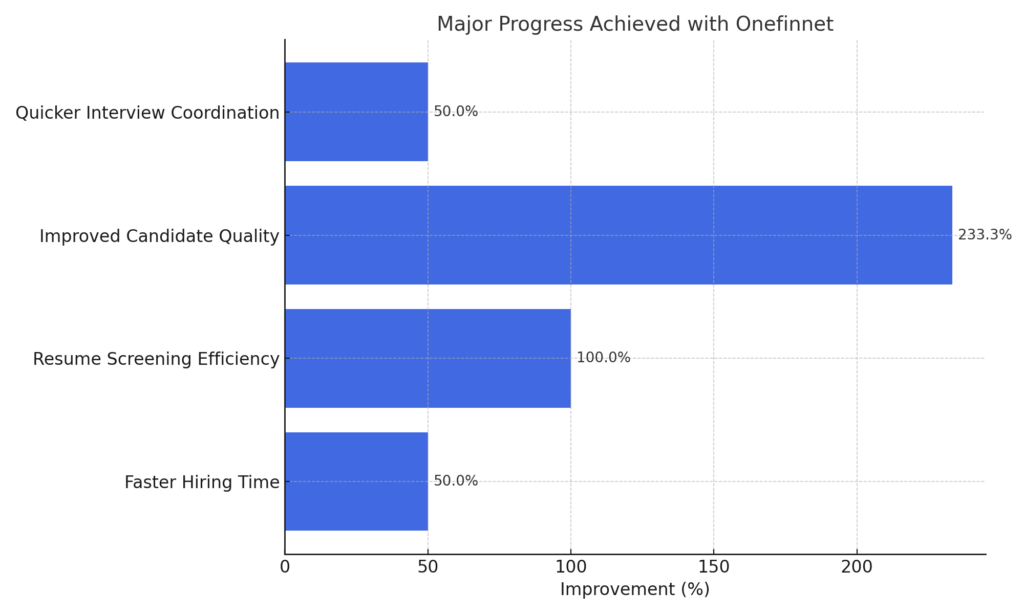
    With Onefinnet Talent, you cut resume screening time by 70%, reduce time-to-hire by 40%, and lower total cost-per-hire by nearly 25% (based on internal pilot studies and typical automation savings). 

    That’s not just a process improvement — that’s ROI you can present in your next management review. 

    The Real Win: Better Hires, Happier Teams 

    The biggest benefit of streamlining hiring isn’t cost, it’s quality. 

     When your process runs smoothly, interviewers actually have time to think, evaluate, and choose the right person. Candidates get timely updates. Managers trust HR again. 

    It’s the difference between hiring someone who “fills a gap” and hiring someone who “fits the team.” 

    And here’s the thing: better hires don’t just perform better, they stay longer. Gallup data shows that engaged employees are 21% more productive and 59% less likely to leave

    That’s the kind of compounding return you only get when your hiring process works end-to-end. 

    In the End, It’s Simple

    Hiring will always be one of your most critical business functions, but it doesn’t have to be your most chaotic. 

    When you remove the manual noise, connect your tools, and bring your data into one place, hiring stops being a cost center. It becomes a growth function. 

    And that’s exactly what Onefinnet Talent is designed to do: help you hire faster, smarter, and more confidently, no matter your industry or team size. 

    If you’re ready to see what that looks like in practice, it’s worth exploring how Onefinnet Talent can help your team simplify hiring, without burning time or budgets. 

  • The CHRO’s Guide to Modern Recruiting

    The CHRO’s Guide to Modern Recruiting

    The CHRO’s Guide to Modern Recruiting can help you navigate the challenges of an outdated recruitment system. Traditional recruiting isn’t just outdated; it’s expensive, risky, and misaligned with today’s workforce. Rising agency fees, short employee tenure, and the illusion of “guarantee periods” mean many organisations are paying far more than they think for every hire.

    This comprehensive eBook, The CHRO’s Guide to Modern Recruiting, uncovers:

    1. The hidden costs of traditional agency models and why they fail in today’s market
    2. How to calculate your real recruiting ROI using a Total Cost of Ownership framework
    3. Modern alternatives, from AI-powered platforms to subscription-based hiring models
    4. A step-by-step implementation roadmap to reduce costs while improving hire quality
    5. Future trends every CHRO must prepare for as we move toward 2026 and beyond

    Backed by case studies, benchmarks, and practical frameworks, this guide helps HR leaders take control of their talent strategy, cut costs by up to 60–70%, and build a sustainable, future-ready recruiting model.

    👉 [Download your copy of the eBook here]

  • The $25000 Gamble: Why Traditional Recruiting Fees Are Broken

    The $25000 Gamble: Why Traditional Recruiting Fees Are Broken

    Sarah, a CHRO at a mid-sized tech company, thought she had found the perfect solution. After weeks of sifting through unqualified applications for a critical engineering role, she partnered with a well-regarded recruiting agency. However, this decision soon felt like the $25000 Gamble: Why Traditional Recruiting Fees Are Broken. Three months later, they delivered exactly what she needed: a talented software engineer with the right experience, cultural fit, and salary expectations of $120,000.

    The invoice arrived shortly after: $24,000 – a standard 20% contingency fee.

    Six months later, that same engineer handed in their resignation to pursue a startup opportunity.

    Sarah’s reaction? A mix of frustration and resignation that’s become all too familiar to CHROs across industries. The $24,000 was gone forever, with no recourse, no refund, and no guarantee period to fall back on.

    This scenario isn’t an outlier. It’s becoming the norm in today’s volatile job market, exposing a fundamental flaw in how recruiting agencies structure their fee models.

    The Guarantee Period Illusion

    Most recruiting agencies proudly advertise their “guarantee periods”, typically 60 to 90 days, as if they’re providing comprehensive protection for their clients. The reality is far more limited.

    According to industry standards, agencies typically offer guarantees structured as follows:

    • Fees under 19%: 60-day guarantee
    • Fees 20% and above: 90-day guarantee
    • Executive searches: Sometimes extend to 120 days

    These guarantees usually come in two forms: money-back (partial or full refund) or replacement guarantees (finding a new candidate at no additional cost).

    But here’s the critical issue: the average employee tenure in many industries now extends well beyond these guarantee periods, yet the real risk of departure and the associated costs continues long after the guarantee expires.

    The True Cost of Hiring Failures

    When we talk about recruiting costs, the agency fee is just the tip of the iceberg. Consider what happens when a $100,000 employee leaves after six months:

    Direct costs:

    • Lost agency fee: $20,000-25,000
    • Onboarding and training: $5,000-15,000
    • Lost productivity during vacancy: $10,000-20,000
    • New search costs: Another $20,000-25,000

    Hidden costs:

    • Team disruption and knowledge transfer
    • Project delays and missed deadlines
    • Decreased team morale
    • Opportunity costs of hiring manager time

    The total impact can easily exceed $75,000 for a single failed hire – yet the traditional agency model provides zero protection beyond the first 60-90 days.

    Why Traditional Models Are Failing Modern Businesses

    The recruiting industry built its fee structure during an era of longer employee tenure and more predictable career paths. In the 1990s and early 2000s, it wasn’t uncommon for employees to stay with companies for 3-5 years or more. A 90-day guarantee covered the adjustment period, and both parties could be reasonably confident in the long-term success of the placement.

    Today’s employment landscape tells a different story:

    • Average tenure for professional roles: 18-24 months
    • Tech industry average: Even shorter at 12-18 months
    • Post-pandemic job mobility: Historic highs

    The mismatch is obvious. Companies are paying premium fees for placements with historically short guarantee periods in an era of unprecedented job mobility.

    The Financial Risk Transfer Problem

    Traditional recruiting operates on a simple principle: transfer all placement risk to the hiring company while maintaining predictable revenue for the agency. This model made sense when hiring was less frequent and tenure was longer.

    But consider the math from an agency’s perspective:

    • Successful placement: Collect 20-25% fee
    • Candidate leaves after 91 days: Keep the fee, no additional obligation
    • Risk exposure: Virtually zero after guarantee period

    Meanwhile, the hiring company bears:

    • Full financial risk of departure
    • All opportunity costs of failed placements
    • Complete restart of search process

    This asymmetric risk distribution increasingly feels outdated and unfair to modern CHROs managing tighter budgets and higher hiring volumes.

    The Rise of Alternative Models

    Progressive companies are beginning to explore alternative approaches that better align with modern hiring realities:

    1. Subscription-based platforms offer predictable monthly costs regardless of hiring volume, removing the per-placement gambling element entirely.
    2. Performance-based partnerships extend guarantee periods or tie fees to longer-term retention metrics.
    3. Technology-first solutions use AI and automation to improve initial screening quality, reducing the likelihood of mis-hires before they happen.
    4. Internal capability building focuses on strengthening in-house recruiting teams rather than outsourcing critical hiring decisions.

    A New Framework for Recruiting ROI

    Smart CHROs are beginning to evaluate recruiting partnerships through a different lens:

    1. Total Cost of Ownership: What’s the all-in cost per successful hire, including failed placements and restart costs?
    2. Risk Distribution: How are placement risks shared between the company and recruiting partner?
    3. Quality Metrics: What mechanisms exist to improve hiring success rates over time?
    4. Scalability: Can the solution grow with hiring volume without proportional cost increases?

    The Path Forward

    The recruiting industry stands at an inflection point. Companies that continue to accept the traditional fee structure are essentially subsidizing an outdated model that doesn’t align with modern employment realities.

    The most forward-thinking organizations are already making the shift. They’re investing in technology-powered solutions that offer predictable costs, better screening capabilities, and aligned incentives.

    For CHROs evaluating their 2026 talent acquisition strategy, the question isn’t whether change is needed – it’s whether you’ll be early or late to adopt a more sustainable approach.

    The $25,000 question remains: Are you comfortable continuing to gamble on 90-day guarantees in a 12-month tenure world?

    The answer, for a growing number of talent leaders, is a resounding no. And that’s driving the most significant shift in recruiting practices we’ve seen in decades.

    The future of recruiting isn’t about finding better agencies – it’s about finding better models entirely.

  • Guide to Scaling Your Hiring Team from 10 to 1000 Employees

    Guide to Scaling Your Hiring Team from 10 to 1000 Employees

    The Growth Challenge That Makes or Breaks Companies

    Every successful company faces the same inevitable challenge: the hiring processes that got you to 10 employees will crash and burn when you try to reach 100, and the systems that work at 100 become impossibly complex at 1000. This guide to scaling your hiring team from 10 to 1000 employees will help navigate these changes.

    The companies that navigate these transitions successfully don’t just grow – they gain massive competitive advantages. Those that fail to adapt find themselves trapped in hiring hell, watching competitors pull ahead while they struggle to staff basic operations.

    The Brutal Reality of Scaling Hiring

    Let’s be brutally honest about what you’re facing. Scaling hiring isn’t just about doing more of the same – it’s about fundamentally reimagining how you find, evaluate, and integrate talent into your organization.

    The rules change at every growth stage, and the companies that thrive are the ones that anticipate these changes before they become desperate needs.

    Phase 1: The Foundation Stage (10-50 Employees)

    Building for Tomorrow While Managing Today

    At this stage, you can still get away with founder-led hiring and informal processes, but smart companies use this phase to build the foundation for future scale. This is where most companies make their first critical mistake: assuming they can wing it forever.

    The Early Warning Signs You’re Hitting Limits

    The warning signs are subtle but unmistakable:

    • Interviews start getting delayed because everyone’s too busy
    • Job descriptions become inconsistent because different managers write them differently
    • Good candidates slip away because nobody owns the follow-up process
    • Decision-making becomes unclear when multiple people are involved

    These aren’t just growing pains – they’re symptoms of a system that’s already breaking down.

    Smart Investments for Phase 1

    Essential Infrastructure Elements:

    1. Clear job description templates for consistency across roles
    2. Standardized interview processes that can be taught to others
    3. Simple but effective ATS systems that can grow with you
    4. Basic hiring metrics to track what’s working
    5. Documentation of your cultural assessment criteria

    Dropbox’s Foundation Success Story

    Dropbox exemplifies this approach perfectly. Even at 30 employees, they invested in hiring processes that could scale, creating the foundation for their explosive growth to 2000+ employees.

    Their Early Investments:

    • Structured interview training for all managers
    • Clear cultural values integrated into hiring decisions
    • Technology infrastructure that could handle 10x growth
    • Documentation of successful hiring patterns

    The Key Insight for Phase 1

    Every hour you spend building hiring systems now saves you weeks of crisis management later. Create role-specific interview guides, establish clear decision-making criteria, and document your processes. These seem like administrative overhead when you’re small, but they become your competitive advantage when growth accelerates.

    Phase 1 Action Checklist

    Immediate Priorities:

    • Document your current hiring process
    • Create standardized job description templates
    • Implement basic ATS functionality
    • Train managers on consistent interviewing
    • Establish clear decision-making criteria
    • Set up basic hiring metrics tracking

    Phase 2: The Complexity Crisis (50-200 Employees)

    Welcome to Hiring Hell

    Welcome to hiring hell. This is where 60% of growing companies completely lose control of their hiring process. The informal systems that worked beautifully at smaller scale become chaotic nightmares.

    The Breaking Point Symptoms

    Coordination Collapse:

    • Multiple hiring managers operating with different standards
    • Candidate experience becomes inconsistent across teams
    • Quality control breaks down entirely
    • Interview scheduling becomes a logistics nightmare

    System Overload:

    • Your simple ATS starts crashing under volume
    • Spreadsheet management becomes impossible
    • Communication gaps create candidate drop-off
    • Data visibility disappears across teams

    Airbnb’s Cultural Crisis and Recovery

    Airbnb nearly destroyed their culture during this phase. Their famous focus on cultural fit worked perfectly when founders could interview every candidate personally. But as they scaled past 100 employees, maintaining cultural standards while hiring quickly became a nightmare.

    Their Crisis Points:

    • Cultural assessment became inconsistent
    • Hiring managers interpreted values differently
    • Speed pressure led to shortcuts
    • Quality candidates were lost to poor experience

    Their Recovery Strategy:

    • Developed scalable cultural assessment tools
    • Trained all interviewers on cultural evaluation
    • Created systematic onboarding for cultural integration
    • Implemented feedback loops for continuous improvement

    Essential Phase 2 Investments

    Specialized Recruiting Team

    The founder-led hiring that got you this far becomes a bottleneck that constrains further growth. You need specialized recruiters who understand your culture and requirements but can operate independently from leadership.

    Key Recruiting Roles:

    • Technical recruiters for engineering and product roles
    • Business recruiters for sales, marketing, and operations
    • Executive recruiters for leadership positions
    • Recruiting coordinators for process management

    Technology Infrastructure Upgrade

    The systems that worked at 50 employees will collapse under the weight of 200. To survive this stage, you need technology that can handle scale, provide visibility, and keep teams aligned.

    Critical Upgrades:

    • Enterprise-grade ATS with workflow automation and robust reporting
    • Scheduling automation tools to eliminate coordination nightmares
    • Centralized communication platforms for hiring teams
    • Analytics dashboards to monitor pipeline health and recruiter performance

    The Key Insight for Phase 2

    Scaling isn’t just about adding people to the recruiting team, it’s about building systems that allow every recruiter to perform at 2–3x efficiency. Companies that invest here prevent hiring chaos from becoming an existential threat.

    Phase 2 Action Checklist

    • Hire specialized recruiters and coordinators
    • Standardize cultural assessments across teams
    • Upgrade to scalable ATS and scheduling tools
    • Implement candidate experience tracking
    • Launch structured onboarding at scale

    Phase 3: The Hypergrowth Challenge (200–1000 Employees)

    This is the make-or-break stage. Hiring becomes not just a function but a competitive differentiator. Your ability to scale talent acquisition directly determines whether you capture market leadership or collapse under your own weight.

    The New Reality

    At this size, you’re hiring dozens or even hundreds of people per quarter. Each misstep compounds across departments, and every delay translates into lost market opportunities. The challenge is no longer just filling roles—it’s about maintaining quality, speed, and culture simultaneously.

    Symptoms of Stress at This Stage:

    • Recruiters burn out under relentless requisition loads
    • Hiring managers complain about “bad fits” despite full pipelines
    • Cultural drift begins eroding the company’s identity
    • Cost-per-hire balloons due to inefficiency and overreliance on agencies

    Stripe’s Hypergrowth Hiring Blueprint

    Stripe scaled from hundreds to thousands of employees in just a few years, all while preserving a strong cultural core. Their playbook offers key lessons:

    What Worked for Stripe:

    • Recruiting as a strategic function: Recruiting leadership had a seat at the executive table
    • Embedded recruiters within departments for deeper alignment
    • Data-driven hiring: Tracking funnel metrics obsessively to spot bottlenecks early
    • Brand investment: Building a reputation that attracted top-tier talent globally

    Essential Phase 3 Investments

    1. Leadership & Structure

    • Establish a Head of Talent Acquisition with executive authority
    • Build specialized recruiting pods (engineering, sales, operations, executive search)
    • Create dedicated employer branding and sourcing teams

    2. Advanced Technology & Automation

    • AI-driven sourcing tools for proactive talent pipelines
    • Automated candidate engagement systems
    • Integrated analytics platforms connecting recruiting with retention data

    3. Culture & Experience Safeguards

    • Scalable onboarding programs that reinforce values from day one
    • Continuous interviewer training for consistency
    • Pulse surveys to ensure candidate and new-hire experience remain high-quality

    The Key Insight for Phase 3

    At hypergrowth, hiring isn’t just an operational process; it’s a strategic weapon. The companies that win are those that treat talent acquisition with the same rigour as product development and customer success.

    Phase 3 Action Checklist

    • Appoint a Head of Talent Acquisition
    • Establish recruiting pods by function
    • Invest in employer brand and sourcing teams
    • Implement AI and automation for sourcing and engagement
    • Build scalable onboarding that reinforces culture
    • Track recruiting metrics as closely as revenue metrics

    The Final Word: Scaling Hiring Is Scaling Culture

    From 10 to 1000 employees, every hiring decision is a culture decision. The infrastructure, systems, and investments you make at each phase determine not just how fast you grow, but whether you grow into the company you want to be.

    Companies that master hiring scale don’t just add headcount; they multiply competitive advantage, turning their recruiting engine into the ultimate moat against competitors.

  • Bulk Hiring vs. Individual Hiring: When to Use Each Strategy

    Bulk Hiring vs. Individual Hiring: When to Use Each Strategy

    The Strategic Decision That Makes or Breaks Your Hiring Success

    The hiring strategy decision that keeps HR leaders awake at night isn’t about finding good candidates – it’s about choosing the right approach for the right situation. With Bulk Hiring vs. Individual Hiring: When to Use Each Strategy being key, should you hire individually with careful precision, or launch into bulk hiring for speed and efficiency?

    Make the wrong choice, and you’ll waste months of time, blow through budgets, and potentially damage your company culture. Make the right choice, and you’ll gain competitive advantages that compound over time.

    The Uncomfortable Reality: Most Companies Choose Wrong

    Let’s start with a reality check that might surprise you: most companies are using the wrong hiring strategy for their actual needs. They default to what feels comfortable rather than what’s strategically optimal.

    Individual hiring feels safer and more controlled, so companies use it even when bulk hiring would be faster and more cost-effective. Conversely, some companies jump into bulk hiring because it sounds efficient, only to discover they’ve sacrificed quality for speed in roles where precision matters most.

    When Individual Hiring Is Your Strategic Weapon

    The Individual Hiring Sweet Spot

    Individual hiring shines when you need precision, customization, and perfect cultural fit. Think of it as hiring with a surgeon’s scalpel rather than a carpenter’s hammer. Each role gets the full attention it deserves, with customized job descriptions, tailored interview processes, and careful consideration of how each hire will impact team dynamics.

    Google’s Individual Hiring Mastery

    Google exemplifies this approach beautifully. Despite their massive scale, they rarely bulk hire engineers because each technical role requires:

    • Specific expertise that varies significantly
    • Team chemistry assessment with existing members
    • Cultural alignment with Google’s unique environment
    • Strategic thinking about product direction

    Their individual hiring process might take months, but the result is teams where every member contributes unique value and fits seamlessly into their collaborative culture.

    Prime Candidates for Individual Hiring

    Leadership and Executive Positions

    A VP of Sales isn’t just filling a slot on your org chart – they’re shaping your entire revenue strategy and team culture. The cost of a bad hire in these positions can reach millions of dollars when you factor in:

    • Wrong strategic decisions
    • Team disruption and turnover
    • Replacement costs and lost momentum
    • Market credibility damage

    Specialized Technical Roles

    When roles require rare skills or deep expertise:

    • Senior software architects designing system foundations
    • Research scientists leading innovation initiatives
    • Cybersecurity experts protecting critical assets
    • Data scientists building algorithmic competitive advantages

    Creative and Innovation Roles

    Creative roles often demand individual attention and assessment:

    • Product designers shaping user experience
    • Content creators defining brand voice
    • Marketing strategists developing positioning
    • Innovation managers driving new initiatives

    When Team Chemistry Is Critical

    Small teams where chemistry is crucial benefit from individual hiring approaches:

    • 5-person product teams need complementary skills and working styles
    • Executive leadership teams require aligned vision and communication
    • Research groups need collaborative and competitive balance
    • Client-facing consultants need relationship-building skills

    The Individual Hiring Process Advantages

    Benefits of Individual Approach:

    1. Deep cultural assessment through multiple touchpoints
    2. Customized evaluation criteria for each unique role
    3. Flexible timeline to find the perfect candidate
    4. Personal relationship building during the process
    5. Thorough reference checking and background verification

    When Bulk Hiring Becomes Your Superpower

    The Bulk Hiring Sweet Spot

    Bulk hiring becomes your superpower when you need similar skills across multiple positions, rapid scaling, or standardized roles with clear requirements. It’s about achieving efficiency at scale while maintaining quality standards through systematic processes.

    Amazon’s Bulk Hiring Excellence

    Amazon’s seasonal hiring of 100,000+ warehouse workers represents bulk hiring mastery. They’ve developed sophisticated systems to assess:

    • Physical capabilities through standardized testing
    • Work ethic and reliability through behavioral assessments
    • Safety consciousness through situational scenarios
    • Learning ability through training simulations

    Their standardized processes ensure consistent quality while achieving the speed necessary to meet holiday demand spikes.

    Perfect Scenarios for Bulk Hiring

    Geographic Expansion

    When companies enter new markets with multiple locations:

    • Starbucks opening 20 stores simultaneously in a new city
    • Bank branches launching across a metropolitan area
    • Retail chains expanding into new states
    • Service companies establishing regional presence

    Seasonal Demand Spikes

    Industries with predictable volume increases:

    • Retail workers for holiday shopping seasons
    • Tax preparers during filing season
    • Tourism staff for peak travel periods
    • Agricultural workers for harvest seasons

    Standardized Role Categories

    Positions with clear, consistent requirements:

    • Sales representatives with defined territories and quotas
    • Customer service agents with standard protocols
    • Delivery drivers with safety and service standards
    • Production workers with specific skill requirements

    The Bulk Hiring Process Advantages

    Benefits of Bulk Approach:

    1. Economy of scale in recruiting and assessment costs
    2. Faster time-to-fill through parallel processing
    3. Consistent quality standards through systematized evaluation
    4. Coordinated onboarding for cultural integration
    5. Data-driven optimization through volume analytics

    The Hybrid Approach: Best of Both Worlds

    Smart Companies Don’t Choose – They Optimize

    The most successful companies are discovering that the individual vs. bulk hiring debate is often a false choice. The most effective strategies combine both approaches strategically, optimizing for speed where possible and precision where necessary.

    Uber’s Strategic Hybrid Model

    Uber provides an excellent example of hybrid hiring strategy:

    Bulk Hiring Categories:

    • Drivers: Standardized requirements, systematic onboarding, scalable processes
    • Customer service reps: Clear competencies, consistent training, volume needs
    • Operations associates: Defined skill sets, standard performance metrics

    Individual Hiring Categories:

    • Product managers: Unique market expertise, strategic thinking, team fit
    • Engineers: Specialized technical skills, innovation capability, cultural alignment
    • Regional directors: Local market knowledge, leadership experience, vision alignment

    Netflix’s Global Expansion Strategy

    Netflix uses a sophisticated hybrid approach during their global expansion:

    Bulk Hiring Focus:

    • Content moderators with clear guidelines and scalable training
    • Customer service representatives with standardized protocols
    • Localization specialists with defined language and cultural requirements

    Individual Hiring Focus:

    • Content creators requiring creative vision and market insight
    • Regional directors needing deep local market knowledge
    • Partnership managers requiring relationship-building and strategic thinking

    The Strategic Decision Framework

    Factor 1: Role Complexity and Requirements

    Choose Individual When:

    • Role requirements are nuanced and complex
    • Success depends on unique combinations of skills
    • Cultural fit is critical to team dynamics
    • Strategic thinking and creativity are essential

    Choose Bulk When:

    • Role requirements are clearly defined and standardized
    • Success metrics are consistent across positions
    • Skills can be systematically assessed and developed
    • Volume and speed are competitive advantages

    Factor 2: Time Sensitivity and Market Dynamics

    Individual Hiring Timeline Factors:

    • Flexibility to wait for exceptional candidates
    • Market conditions favor selectivity
    • Long-term role impact justifies extended search
    • Quality is more important than speed

    Bulk Hiring Timeline Drivers:

    • Competitive pressure requiring fast market entry
    • Operational deadlines that can’t be delayed
    • Seasonal or cyclical business demands
    • Growth opportunities with time constraints

    Factor 3: Impact of Hiring Mistakes

    High-Stakes Roles (Individual Approach):

    • Leadership positions: Wrong hire can derail entire teams
    • Client-facing roles: Poor performance damages relationships
    • Technical architects: Bad decisions affect entire systems
    • Brand representatives: Quality directly impacts reputation

    Standardized Roles (Bulk Approach):

    • Process-driven positions: Clear procedures minimize individual impact
    • Team-based work: Group performance compensates for individual variations
    • Training-heavy roles: Systems can develop capabilities
    • Volume positions: Statistical quality control manages overall performance

    Factor 4: Technology and Resource Capabilities

    Individual Hiring Requirements:

    • Flexible ATS that handles custom workflows
    • Experienced recruiters with relationship-building skills
    • Interview coordination for multiple stakeholders
    • Comprehensive background checking capabilities

    Bulk Hiring Infrastructure Needs:

    • Scalable technology that handles volume efficiently
    • Standardized assessment tools and processes
    • Project management capabilities for coordination
    • Data analytics for process optimization

    Making the Right Choice: Assessment Tools

    The Hiring Strategy Decision Matrix

    Questions to Determine Approach:

    1. Can role requirements be clearly standardized?
      • Yes → Bulk hiring potential
      • No → Individual hiring likely better
    2. How critical is perfect cultural fit?
      • Critical → Individual approach
      • Important but trainable → Bulk approach possible
    3. What’s the cost of a hiring mistake?
      • Very high → Individual hiring justified
      • Manageable → Bulk hiring acceptable
    4. Do you need 10+ similar roles filled quickly?
      • Yes → Bulk hiring advantages
      • No → Individual hiring sufficient
    5. Are success metrics consistent across positions?
      • Yes → Bulk hiring works well
      • No → Individual assessment needed

    Common Decision Mistakes to Avoid

    1st Mistake: Choosing individual hiring for standardised roles due to comfort.

    2nd Mistake: Rushing into bulk hiring for complex roles to save time

    3rd Mistake: Not considering hybrid approaches for mixed requirements.

    4th Mistake: Ignoring technology limitations that force suboptimal choices.

    5th Mistake: Making emotional rather than strategic decisions.

    Optimizing for Success: Best Practices

    Individual Hiring Excellence

    Key Success Factors:

    1. Invest time in role definition and success criteria
    2. Create compelling candidate experiences that attract top talent
    3. Use multiple assessment methods for comprehensive evaluation
    4. Build strong hiring manager capabilities for effective interviews
    5. Maintain candidate relationships even when not immediately hiring

    Bulk Hiring Excellence

    Key Success Factors:

    1. Develop standardized processes that can be replicated consistently
    2. Invest in scalable technology before you need it
    3. Create quality control checkpoints throughout the process
    4. Train multiple team members on bulk hiring coordination
    5. Build candidate experience systems that work at scale

    Hybrid Approach Excellence

    Integration Strategies:

    1. Clear criteria for which approach to use when
    2. Shared technology platforms that support both methods
    3. Cross-trained teams that can execute either approach
    4. Consistent employer branding across both processes
    5. Data integration for comprehensive hiring analytics

    The Competitive Advantage of Strategic Hiring

    Why This Decision Matters More Than Ever

    In today’s competitive talent market, companies that make smart hiring strategy decisions gain compound advantages:

    Speed Advantages:

    • Faster response to market opportunities
    • Quick scaling for growth initiatives
    • Rapid competitive moves

    Quality Advantages:

    • Better role-fit through appropriate assessment depth
    • Higher retention through strategic selection
    • Stronger team performance

    Cost Advantages:

    • Lower per-hire costs through process efficiency
    • Reduced turnover through better matching
    • Improved productivity from faster filling

    The Bottom Line: Strategy Over Habit

    The most successful companies don’t choose between individual and bulk hiring based on comfort or habit – they match their method to their specific needs, timeline, and quality requirements.

    Critical Success Questions:

    1. Are you optimizing for the right outcomes, or defaulting to familiar approaches?
    2. How many times did you use individual hiring when bulk would have been faster and equally effective?
    3. How many times did you rush into bulk hiring when individual attention would have prevented costly mistakes?
    4. What hiring capabilities do you need to build to execute both strategies effectively?

    The companies winning in today’s market aren’t just good at hiring – they’re strategic about how they hire. They understand that hiring strategy isn’t about finding one perfect approach; it’s about building the capability to use the right approach for each situation.

    What’s your hiring strategy really optimizing for, and how can you build the capabilities to make better strategic choices?

  • AI in Recruitment: Transforming the Hiring Landscape

    AI in Recruitment: Transforming the Hiring Landscape

    Artificial intelligence is fundamentally reshaping how organisations approach talent acquisition. AI in Recruitment: Transforming the Hiring Landscape to Streamline Recruitment Processes and Optimise Candidate Selection, AI tools are revolutionising how companies identify, engage, and hire top talent. Indeed, AI in Recruitment is transforming the hiring landscape.

    The impact extends far beyond simple automation. AI empowers HR professionals to make strategic, data-driven decisions that result in superior hiring outcomes and enhanced operational efficiency. But what does this transformation actually look like in practice, and how is AI reshaping traditional recruitment methodologies? Understanding the influence of AI in Recruitment: Transforming the Hiring Landscape reveals its true potential.

    Six Key Advantages of AI-Powered Recruitment

    Implementing AI in hiring processes delivers transformative benefits that enhance both speed and quality while promoting fairness and strategic focus. This highlights AI in Recruitment as transforming the hiring landscape significantly.

    Enhanced Candidate Discovery and Screening

    AI dramatically expands talent sourcing capabilities by rapidly analyzing thousands of resumes to identify candidates with specific skills and experience. Through natural language processing (NLP), AI systems can interpret contextual information and uncover highly qualified candidates that traditional screening methods might overlook.

    Elevated Candidate Experience

    In today’s competitive talent market, candidate experience is crucial. AI enables personalized, one-on-one interactions through chatbots and virtual assistants, providing instant feedback, application status updates, and responsive communication around the clock. This is another example of how AI in Recruitment is transforming the hiring landscape by improving candidate experience.

    Data-Driven Strategic Decision Making

    AI excels at pattern recognition and predictive analytics, offering valuable insights into recruitment effectiveness. By analyzing historical data, AI can identify the most productive candidate sources, highlight characteristics of successful employees, and recommend process optimizations. This evidence-based approach minimizes bias and ensures decisions are grounded in objective data.

    Accelerated Hiring Timelines

    Traditional recruitment often involved lengthy delays. AI automates administrative tasks such as interview scheduling and candidate communication, significantly reducing time-to-hire. Advanced AI can even analyze video interviews, assessing vocal patterns and non-verbal cues to provide deeper candidate insights during initial evaluations. Such advancements demonstrate AI in Recruitment: Transforming the Hiring Landscape through improved efficiency.

    Promotion of Inclusive Hiring

    AI has the potential to reduce unconscious bias by focusing hiring decisions on candidates’ qualifications and potential rather than demographic characteristics. This approach helps organizations attract diverse talent pools and foster inclusive, innovative workplace cultures. Thus, AI in Recruitment continues transforming the hiring landscape by promoting inclusivity.

    Real-World Success Stories

    Case Study 1: Tech Startup Automation

    A technology startup implemented AI to streamline their candidate sourcing process. By training their AI platform to recognize specific technical competencies, they dramatically reduced the time required to identify and shortlist qualified candidates, enabling faster filling of critical positions.

    Case Study 2: Global Corporation’s Enhanced Communication

    A multinational organization deployed AI chatbots to manage candidate communications. These 24/7 systems provided real-time application updates and answered frequently asked questions, significantly improving candidate satisfaction and engagement levels.

    Case Study 3: Professional Services Analytics

    A leading professional services firm leveraged AI to analyze their recruitment data comprehensively. By examining hiring patterns and tracking new hire performance over time, they identified optimal sourcing strategies and interview techniques, resulting in measurably improved hire quality.

    In each scenario, AI not only accelerated hiring processes but also generated strategic insights that enhanced decision-making quality and aligned recruitment efforts more closely with organizational objectives. These cases show AI in Recruitment: Transforming the Hiring Landscape through strategic implementation.

    Moving Forward

    The integration of AI in recruitment represents a pivotal advancement in human resources. Organizations that thoughtfully implement AI solutions can deliver more inclusive, efficient hiring processes that drive superior business outcomes.

    However, successful AI adoption requires careful consideration, transparency, and commitment to continuous improvement. As we advance toward increasingly technology-enabled HR environments, maintaining focus on finding the right talent to drive organizational growth remains paramount.

    The future of recruitment lies in leveraging AI’s capabilities while preserving the human elements that make hiring successful. When implemented strategically, AI opens unlimited possibilities for transforming talent acquisition practices. This clearly encapsulates the role of AI in Recruitment: Transforming the Hiring Landscape effectively.

  • Healthcare Provider Tripled Its Interview Ratio Success 

    Healthcare Provider Tripled Its Interview Ratio Success 

    About the Organization 

    This regional healthcare provider runs a fast-expanding network of multispecialty clinics and diagnostic centres across Southeast Asia. After securing fresh institutional funding, the organisation faced its next challenge: rapidly scaling both care delivery and administrative staff to keep pace with demand. nterestingly, the healthcare provider not only tripled its interview ratio success using Onefinnet but also managed to handle surging patient demand more effectively. As a result, it was able to maintain both quality and compliance without compromise.

    Moreover, this achievement is significant because it highlights adaptability in a highly demanding sector. Remarkably, this case further exemplifies how a healthcare provider successfully tripled its interview ratio in a busy medical landscape, thereby setting a strong precedent for others in the industry.

    In this case study, we’ll break down how they addressed these hiring pressures: reducing time-to-hire, improving candidate quality, and staying fully aligned with regulatory standards by partnering with Onefinnet.

    The Hiring Challenge Before Onefinnet

    The pace of growth created urgent hiring needs across clinical, operational, and support roles. However, several issues stalled the process:

    • To begin with, high candidate drop-off rates, qualified professionals often ghosted after initial rounds or accepted faster offers elsewhere.
    • Additionally, unclear role requirements, especially for new roles in telehealth and operations, led to poor fits and interview fatigue.
    • On top of that, scheduling delays became a major hurdle, as distributed teams and rotating shifts turned interview coordination into a logistical bottleneck.

    The Onefinnet Solution 

    Onefinnet stepped in with a structured yet flexible hiring system tailored to the realities of healthcare, which led to the fact that this healthcare provider tripled its interview ratio success.

    • Kicked off with a role alignment workshop involving hiring managers, HR, and medical leads to ensure clarity from the start
    • Followed by developing competency-based job scorecards tailored to both clinical and non-clinical roles
    • With that foundation in place, we delivered screened candidates who matched the required skills and were available for specific shifts.
    • At the same time, we enabled asynchronous candidate reviews and feedback loops through the OneFinNet platform, minimizing back-and-forth and reducing decision delays, thereby showing how a healthcare provider tripled its interview ratio success.

    The Transformation 

    Within just 45 days:

    • The interview-to-hire ratio improved from 1:7 to 1:2, significantly increasing decision efficiency
    • 80% of shortlisted candidates were interviewed within three days of being submitted, speeding up the process
    • Drop-offs fell by 50%, driven by clearer expectations and quicker turnarounds
    • Hiring teams reported reduced administrative overhead and faster closure on open roles. This showcases how the healthcare provider tripled its interview ratio success.

    Timeline: Speed Meets Structure 

    • Week 1: Role calibration + competency scorecards 
    • Weeks 2–3: Candidate submissions, screening, and shortlisting 
    • Weeks 4–5: Interviews completed and offers rolled out 
    • Week 6+: Ongoing candidate flow, performance tracking, and refinement 

  • Outsourcing firm Reduced Time-to-Hire Using Onefinnet Talent 

    Outsourcing firm Reduced Time-to-Hire Using Onefinnet Talent 

    About the Company 

    This fast-growing outsourcing and managed services firm specialises in back-office support, customer service, and data operations for clients across North America and Europe. With a team of 200+ and a rapidly expanding client base, agility and quality are critical to their delivery model. 

    The Hiring Challenge 

    As this firm scaled, so did their hiring needs, especially mid-level operations and customer service roles. However, they faced three core challenges: 

    • Long hiring cycles: It took 30–45 days to fill operational roles, causing project delays. 
    • Poor quality of applicants: Sourcing through traditional job portals resulted in mismatched profiles and high interview dropouts. 
    • Inconsistent screening: Their internal hiring team was spending too much time filtering through irrelevant resumes. 

    They needed a solution that would streamline the process and surface talent that was both qualified and ready to move fast. 

    The Onefinnet Solution 

    Onefinnet stepped in with a simple promise: streamline hiring without the noise. Here’s how we tackled their pain points: 

    • Built a custom hiring workflow aligned with their business operations. 
    • Screened 1000+ resumes within minutes to surface top matches. 
    • Delivered high-quality candidates that matched the firm’s exact needs, no irrelevant profiles, no time wasted. 
    • Centralised interview coordination through Onefinnet’s talent dashboard. 

    The Transformation 

    In less than 60 days, the firm saw a dramatic shift in its hiring process: 

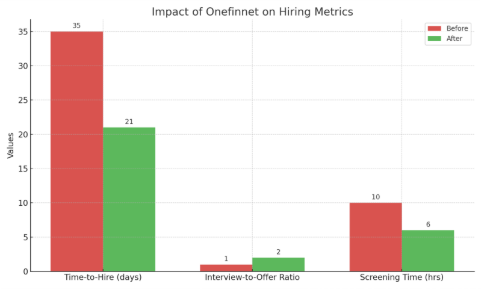
    • Time-to-hire dropped by 40% from 35 days to just 21. 
    • The interview-to-offer ratio improved by 2x, thanks to better candidate fit. 
    • Hiring managers reported a 40% reduction in screening time
    • New hires had better onboarding outcomes, with higher engagement in the first 90 days. 

    Timeline: From First Call to Optimisation 

    • Week 1: Discovery call and alignment on hiring needs 
    • Week 2–3: Workflow setup and launch of pilot talent pool 
    • Week 4–6: Initial hires made; feedback loop integrated 
    • Week 7–8: Full optimisation, real-time access to new talent and automated updates 
    • By Week 9: Time-to-hire reduced by 40%, and process fully integrated with internal HR 
  • How Slow Manual Hiring Lose Top Talent to Competitors

    How Slow Manual Hiring Lose Top Talent to Competitors

    David Kim was exactly what TechCorp had been searching for. With a computer science degree from Stanford, 8 years of experience at Google, and a track record of leading teams that shipped products used by millions, he was the perfect candidate for their VP of Engineering position. However, how slow manual hiring processes can lose top talent to competitors became apparent when they delayed reaching out to him.

    David applied on a Monday morning, excited about the opportunity to join a company he’d been following for years. He submitted his application through their careers page and waited.

    And waited.

    1st Week: No response. David assumed they were busy and remained patient.

    2nd Week: Still nothing. He started wondering if his application had been received.

    3rd Week: David received a generic email acknowledging his application and promising a response “within the next few weeks.”

    4th Week: Growing frustrated, David began responding to LinkedIn messages from other companies.

    5th Week: A competitor reached out, conducted a phone screen within 24 hours, and scheduled an onsite interview for the following week.

    6th Week: While TechCorp was still “reviewing applications,” David received and accepted an offer from their biggest competitor, a company that moved from application to offer in just 12 days.

    TechCorp finally called David in Week 7, only to learn he’d already started his new job. The position remained open for another 3 months, during which their main competitor, now led by David, launched a product that captured 34% of TechCorp’s market share.

    This story plays out thousands of times each day across industries. In today’s competitive talent market, speed isn’t just important, it’s everything.

    The Speed Imperative: Why Time Matters More Than Ever

    In the modern job market, top talent moves fast. Consider these sobering statistics:

    The Talent Lifecycle

    • 10 days: Average time top candidates stay on the market
    • 3 days: Time before A-players start considering other opportunities
    • 7 days: Point where candidate interest begins to decline significantly
    • 14 days: When 67% of candidates assume they’ve been rejected

    The Competition Factor

    • 4.7 companies on average compete for each top-tier candidate
    • 2.3 days: Average response time of companies using AI-powered hiring
    • 18 days: Average response time of companies using manual processes
    • 780% faster: How quickly AI-powered companies can identify and contact candidates

    The Staggering Cost of Slow Hiring

    Direct Financial Impact

    Lost Revenue Opportunities

    • Empty positions cost companies an average of $4,129 per day in lost productivity
    • Senior leadership roles cost $14,000+ per day when vacant
    • Technical positions in fast-growing companies cost $8,500+ per day

    Extended Hiring Costs

    • Each additional week of hiring increases costs by 23%
    • Prolonged searches require 67% more recruiter time
    • Late-stage candidate dropouts cost an average of $15,000 per position

    The Opportunity Cost Multiplier

    CompetitorCorp vs. SlowCorp Case Study:

    • CompetitorCorp (AI-powered hiring): Filled 50 positions in 3 months
    • SlowCorp (manual hiring): Filled 50 positions in 8 months

    The result? CompetitorCorp launched two major products while SlowCorp was still hiring. By the time SlowCorp reached full capacity, CompetitorCorp had captured 40% additional market share and generated $12 million in extra revenue.

    The Hidden Costs of Manual Hiring

    Administrative Burden

    Manual hiring processes don’t just slow down candidate responses, they consume massive amounts of internal resources. Consider the typical workflow:

    Resume Screening: HR teams spend an average of 6 seconds per resume, yet must review hundreds for each position. A single role can require 40+ hours of manual screening time.

    Interview Coordination: Scheduling interviews across multiple stakeholders takes an average of 3.2 hours per candidate. For a typical hiring funnel, this represents 64 hours of coordination time per hire.

    Reference Checks: Manual reference verification takes 2-4 days per candidate, often delayed by scheduling conflicts and slow responses.

    The Compound Effect

    These delays don’t just add up, they multiply. When your hiring process takes 45 days instead of 15, you’re not just losing 30 days per hire. You’re losing:

    • Top-tier candidates who’ve already accepted other offers
    • Internal momentum as teams remain understaffed
    • Competitive advantage as rivals outpace your growth
    • Company reputation as candidates share negative experiences

    The Quality Paradox

    Here’s the counterintuitive truth: slower hiring doesn’t mean better hiring. In fact, the opposite is often true.

    Why Fast Hiring Improves Quality

    1. First-mover advantage: The best candidates evaluate opportunities in the order they arrive. Being first in line means accessing the highest-quality talent pool.
    2. Reduced bias: Lengthy processes introduce more opportunities for unconscious bias to influence decisions. Streamlined processes focus on core competencies and culture fit.
    3. Better candidate experience: Top performers expect professionalism and efficiency. Companies that respect candidates’ time signal they’ll respect employees’ time.
    4. Increased acceptance rates: Candidates who experience smooth, fast processes are 73% more likely to accept offers compared to those who endure lengthy, disorganized hiring experiences.

    The AI Advantage: Speed Without Sacrifice

    Modern AI-powered hiring platforms are revolutionizing recruitment by automating time-consuming tasks while maintaining quality standards:

    Intelligent Resume Screening

    AI can analyze thousands of resumes in minutes, identifying relevant skills, experience patterns, and cultural fit indicators that would take human recruiters hours to evaluate.

    Automated Interview Scheduling

    Smart scheduling systems coordinate across multiple calendars, automatically finding optimal times and sending confirmations—reducing coordination time by 85%.

    Predictive Analytics

    AI systems analyze historical hiring data to predict which candidates are most likely to succeed, accept offers, and remain with the company long-term.

    Real-time Communication

    Automated updates keep candidates informed throughout the process, maintaining engagement and reducing dropout rates.

    The Competitive Landscape: A Tale of Two Companies

    MegaCorp (Traditional Hiring):

    • Average time-to-hire: 52 days
    • Candidate dropout rate: 34%
    • Offer acceptance rate: 68%
    • Cost per hire: $18,500

    AgileStart (AI-Powered Hiring):

    • Average time-to-hire: 14 days
    • Candidate dropout rate: 8%
    • Offer acceptance rate: 89%
    • Cost per hire: $7,200

    The results speak for themselves. AgileStart consistently attracts higher-quality candidates, fills positions faster, and operates at a fraction of the cost. More importantly, they’re building teams that can execute quickly, a crucial advantage in today’s fast-paced business environment.

    The Network Effect

    Speed in hiring creates a virtuous cycle. When you consistently provide excellent candidate experiences, several things happen:

    1. Referral multiplier: Happy candidates refer other top performers, creating a pipeline of pre-qualified talent.
    2. Employer brand strength: Your reputation as an efficient, candidate-friendly company spreads through professional networks.
    3. Competitive intelligence: Candidates who’ve interviewed with you (even if not hired) often share valuable market insights about competitor strategies and talent movements.
    4. Alumni network: Former candidates who were impressed by your process often become future employees, customers, or partners.

    Breaking the Speed Barriers

    Common Bottlenecks and Solutions

    1. Decision-making delays: Establish clear hiring criteria and decision-making authority. Implement structured scorecards that streamline evaluation.
    2. Interview availability: Use AI scheduling tools and maintain flexible interview slots. Consider asynchronous video interviews for initial screenings.
    3. Reference check delays: Implement automated reference check systems that can gather feedback quickly and efficiently.
    4. Approval processes: Streamline offer approval workflows. Pre-approve salary ranges and benefits packages to eliminate last-minute delays.

    Building a Speed-First Culture

    1. Executive commitment: Leadership must model urgency in hiring decisions. When executives prioritize speed, the entire organization follows.
    2. Process ownership: Assign dedicated hiring managers who are accountable for timeline adherence and candidate experience.
    3. Metrics tracking: Measure and report on time-to-hire, candidate satisfaction, and conversion rates at each stage.
    4. Continuous improvement: Regularly review and optimize your hiring process based on data and feedback.

    The Future of Hiring: Speed as a Core Competency

    Companies that master fast hiring will have a sustainable competitive advantage. As the war for talent intensifies, the ability to identify, attract, and secure top performers quickly will separate winners from losers.

    The question isn’t whether you can afford to invest in faster hiring processes, it’s whether you can afford not to. Every day you delay is another day your competitors are building stronger teams, launching better products, and capturing more market share.

    Action Steps: Accelerating Your Hiring Today

    1. Audit your current process: Map every step from application to offer acceptance. Identify bottlenecks and unnecessary delays.
    2. Invest in AI tools: Implement resume screening, interview scheduling, and candidate communication automation.
    3. Establish SLAs: Set service level agreements for each stage of your hiring process and hold teams accountable.
    4. Create decision frameworks: Develop clear criteria and processes for making hiring decisions quickly without sacrificing quality.
    5. Train your team: Ensure everyone involved in hiring understands the importance of speed and knows how to execute efficiently.
    6. Monitor and optimize: Track key metrics and continuously refine your process based on performance data.

    Conclusion: The Need for Speed

    In today’s hypercompetitive business environment, hiring speed isn’t just a nice-to-have, it’s a strategic imperative. Companies that can identify, evaluate, and secure top talent quickly will build stronger teams, launch better products, and ultimately dominate their markets.

    The choice is clear: evolve your hiring process for speed, or watch your competitors hire the talent you need to succeed. The clock is ticking, and in the race for top talent, there are no participation trophies, only winners and losers.

    David Kim’s story is playing out right now in companies across every industry. The question is: will you be TechCorp, watching great candidates slip away, or will you be the company that moves fast enough to secure the talent that drives success?

    The future belongs to the swift. Make sure you’re ready to run.

  • How Manual Hiring Processes Burn Out HR Teams

    How Manual Hiring Processes Burn Out HR Teams

    Jennifer Martinez stared at her reflection in the bathroom mirror, noticing the dark circles under her eyes had become permanent fixtures. As the HR Director at a fast-growing tech startup, she had joined the company 18 months ago with ambitious plans to build a world-class people strategy. Instead, she found herself drowning in an endless sea of resume screening, interview scheduling, and candidate communications, exemplifying how manual hiring processes burn out HR teams.

    Yesterday alone, she had:

    • Screened 67 resumes for three different positions
    • Scheduled 23 interviews across multiple time zones
    • Sent 89 status update emails to candidates
    • Updated 15 different spreadsheets with candidate information
    • Attended 4 hiring manager meetings about the same positions

    It was 9:47 PM, and she was still at her desk, manually entering candidate data into their tracking system. The strategic HR initiatives she’d been hired to implement, employee development programs, culture building, and retention strategies, remained untouched, buried under the relentless administrative burden of manual hiring.

    Jennifer’s story isn’t unique. Across industries, HR professionals are burning out at alarming rates, not because they lack passion for their work, but because manual hiring processes have transformed them from strategic business partners into administrative assistants.

    The HR Burnout Crisis: By the Numbers

    The statistics paint a stark picture of an industry in distress:

    Burnout Rates

    • 71% of HR professionals report experiencing burnout
    • 58% are actively seeking new jobs due to workload stress
    • 43% of HR departments report understaffing issues
    • 67% of HR leaders feel they spend too much time on administrative tasks

    Time Allocation Crisis

    HR professionals spend their time on:

    • Administrative tasks: 41% (including 23% on manual hiring processes)
    • Strategic initiatives: 19%
    • Employee development: 16%
    • Culture building: 12%
    • Compliance: 12%

    This means that for every hour spent on strategic HR work, 2.2 hours are consumed by administrative busywork.

    The Real Cost of Manual Hiring on HR Teams

    1. Time Hemorrhage: The 40-Hour Hidden Job

    For every open position, manual hiring processes require:

    Initial Setup (2 hours)

    • Creating job descriptions
    • Posting across multiple platforms
    • Setting up tracking systems

    Resume Screening (15-25 hours)

    • Initial review: 8 minutes per resume × 200 applications = 27 hours
    • Detailed analysis of top candidates: 2 hours
    • Creating shortlists and notes: 3 hours

    Interview Coordination (8-12 hours)

    • Scheduling interviews: 15 minutes per candidate × 20 candidates = 5 hours
    • Rescheduling conflicts: 3 hours
    • Preparing interview materials: 2 hours

    Communication Management (6-8 hours)

    • Status updates to candidates: 4 hours
    • Feedback collection and distribution: 2 hours
    • Rejection notifications: 2 hours

    Data Management (4-6 hours)

    • Updating tracking systems: 3 hours
    • Generating reports: 2 hours
    • File organization: 1 hour

    Total: 35-53 hours per position

    For a company hiring 30 positions annually, this represents 1,050-1,590 hours of manual labor, equivalent to hiring an additional full-time employee just for administrative hiring tasks.

    2. The Error Epidemic

    Manual processes lead to cascading errors:

    Data Entry Mistakes

    • 34% of candidate information contains errors
    • 23% of interview schedules require correction
    • 67% of hiring reports contain outdated information

    Communication Failures

    • 45% of candidates report receiving conflicting information
    • 29% of interview times are miscommunicated
    • 56% of rejection emails are sent to wrong candidates

    Compliance Risks

    • 78% of manual hiring processes have compliance gaps
    • 23% of companies face legal risks due to documentation errors
    • 67% of EEOC complaints stem from poor record-keeping

    Real-World Consequences: The Human Cost

    The $2.3 Million Turnover

    TechCorp’s HR team of 8 professionals was processing 150+ positions annually using manual processes. The administrative burden led to:

    • 67% annual turnover in the HR department
    • $347,000 in recruitment costs for HR replacements
    • $892,000 in training and onboarding costs
    • $1.1 million in lost productivity during transitions
    • 6-month delays in strategic initiatives

    The Breakdown

    Sarah Chen, Senior HR Manager at GrowthStartup, experienced a complete breakdown after 14 months of manual hiring overload:

    • 70-hour work weeks became the norm
    • Missed 34 family events due to work demands
    • Developed anxiety disorder requiring medical treatment
    • Resigned without notice, leaving the company scrambling

    Her replacement cost $89,000 to recruit and train, plus 3 months of delayed hiring for 12 critical positions.

    The Strategic Sacrifice

    MegaCorp’s HR team was so overwhelmed with manual hiring that they:

    • Cancelled leadership development programs affecting 200+ employees
    • Postponed diversity initiatives for 18 months
    • Eliminated employee satisfaction surveys for 2 years
    • Reduced performance management support by 67%

    The result: 23% increase in overall employee turnover, costing $4.7 million in replacement costs.

    The Opportunity Cost: What HR Could Be Doing Instead

    While HR teams are buried in manual hiring tasks, critical strategic initiatives suffer:

    Employee Development (Lost Value: $1.2M annually)

    • Skill development programs: Increase productivity by 23%
    • Leadership training: Reduce management turnover by 34%
    • Career pathing: Improve retention by 45%

    Culture Building (Lost Value: $890K annually)

    • Employee engagement: Increase productivity by 18%
    • Team building: Reduce conflict by 56%
    • Recognition programs: Improve satisfaction by 67%

    Retention Strategies (Lost Value: $2.1M annually)

    • Exit interview analysis: Identify turnover patterns
    • Predictive analytics: Prevent departures before they happen
    • Compensation optimization: Ensure competitive packages

    Strategic Planning (Lost Value: $1.6M annually)

    • Workforce planning: Anticipate future needs
    • Succession planning: Prepare for leadership transitions
    • Organizational design: Optimize team structures

    The Psychological Impact: Beyond the Numbers

    Stress and Anxiety

    Manual hiring processes create constant stress:

    • 89% of HR professionals report job-related anxiety
    • 76% experience sleep disruption due to work stress
    • 67% report relationship strain from work demands

    Job Satisfaction Decline

    • Only 23% of HR professionals report being “very satisfied” with their work
    • 78% feel their skills are underutilized
    • 65% believe their work lacks strategic impact

    Career Stagnation

    • 45% of HR professionals feel stuck in administrative roles
    • 67% believe manual processes prevent career advancement
    • 34% have considered leaving HR entirely

    The Ripple Effect: How HR Burnout Impacts Organizations

    Hiring Quality Degradation

    Burned-out HR teams make poor hiring decisions:

    • 43% increase in bad hires
    • 67% longer time-to-fill positions
    • 56% higher candidate dropout rates

    Employee Experience Deterioration

    Overwhelmed HR teams can’t support employees:

    • 34% decline in employee satisfaction
    • 45% increase in internal complaints
    • 67% longer resolution times for HR issues

    Business Performance Impact

    • 23% increase in overall employee turnover
    • $2.3 million average annual cost of HR dysfunction
    • 67% of strategic initiatives delayed or cancelled

    The Technology Solution: AI-Powered Liberation

    Organizations implementing AI-powered hiring solutions report dramatic improvements in HR team well-being:

    Time Liberation

    • 78% reduction in administrative hiring tasks
    • 67% increase in strategic work time
    • 45% improvement in work-life balance

    Stress Reduction

    • 89% decrease in job-related anxiety
    • 76% improvement in job satisfaction
    • 67% reduction in overtime requirements

    Career Advancement

    • 56% of HR professionals report increased strategic responsibilities
    • 78% feel more valued by leadership
    • 67% report improved career progression

    Success Stories: The Transformation

    TechForward’s Revolution

    After implementing AI-powered hiring:

    • HR team size reduced from 12 to 8 while handling 40% more positions
    • Strategic initiatives increased by 234%
    • Employee satisfaction improved by 67%
    • HR turnover dropped from 45% to 8%

    GlobalCorp’s Renaissance

    AI transformation results:

    • Administrative time reduced by 78%
    • Employee development programs launched for 2,000+ employees
    • Culture initiatives increased by 156%
    • HR team satisfaction improved by 89%

    The Path Forward: Reclaiming Strategic HR

    Immediate Actions

    1. Audit current time allocation across HR team
    2. Identify manual tasks that can be automated
    3. Calculate the true cost of manual processes
    4. Prioritize strategic initiatives being neglected

    Technology Implementation

    1. AI-powered resume screening to eliminate manual review
    2. Automated interview scheduling to reduce coordination time
    3. Intelligent candidate communication to streamline updates
    4. Integrated analytics to replace manual reporting

    Strategic Reallocation

    1. Redeploy saved time to strategic initiatives
    2. Invest in HR team development and upskilling
    3. Create career growth paths within strategic HR roles
    4. Measure success through strategic impact metrics

    The Business Case for Change

    The financial argument for eliminating manual hiring processes is compelling:

    Direct Savings

    • $156,000 annual savings per HR professional through time reallocation
    • $347,000 reduced recruitment costs for HR replacements
    • $892,000 savings on training and onboarding

    Strategic Value Creation

    • $2.1 million annual value from retention strategies
    • $1.6 million value from strategic planning initiatives
    • $890,000 value from culture building programs

    ROI Calculation

    For every $1 invested in AI-powered hiring solutions:

    • $4.7 return through reduced administrative costs
    • $8.3 return through strategic value creation
    • $12.1 return through improved employee outcomes

    Conclusion: The Choice is Clear

    Jennifer Martinez’s story doesn’t have to be your reality. The technology exists to liberate HR teams from the administrative nightmare of manual hiring processes. The question isn’t whether you can afford to implement AI-powered solutions; it’s whether you can afford not to.

    Every day you delay is another day your HR team burns out, your strategic initiatives suffer, and your competitors gain an advantage. The human cost of manual hiring extends far beyond inefficiency; it’s destroying the very people you depend on to build your organisation’s future.

    The transformation is possible. The technology is available. The only question is: will you act before it’s too late?

    Ready to liberate your HR team from administrative burnout and unleash their strategic potential? Discover how AI-powered hiring solutions can transform your HR department from order-takers to business leaders.